
Achieving Data Mastery through Literacy and Standardization

Setting clear objectives and ensuring cohesiveness can enable manufacturers to be deliberate and intentional in executing a data strategy.

TAKEAWAYS:
● Manufacturers must first determine an objective for data mastery and prioritize potential quick wins as the first step.
● Data from customers, suppliers, and the shop floor must be harmonized to standardize inputs, KPIs, and other important metrics.
● Manufacturers must also assess their teams’ data literacy and then determine what training is necessary to develop organizational cohesiveness.
Manufacturers understand that data will be foundational in developing increasingly efficient factories of the future, an essential tool to guide better decision-making at every level of the business. As digitization becomes more commonplace on factory floors and data becomes progressively central to operations, manufacturers need to be ever more intentional about how they tap into that data.
That intentionality can be more challenging than it seems on the surface. There are two foundational efforts that can help manufacturers on this front: setting clear objectives for how the business wants to use data to its fullest extent and ensuring teams across the organization have a cohesive level of data literacy. Both efforts enable the organization to be more deliberate in execution.
The first mission, determining an objective, may seem straightforward enough. But with how ubiquitous data has become throughout manufacturing operations and production processes, teams may find it challenging to rank their priorities. While predictive machine learning processes may be appealing, for instance, implementing such processes can be more time-consuming and challenging than, say, identifying manual processes where data might help to increase workers’ efficiency. Identifying potential quick wins should be top of mind for leadership teams assessing how to improve their data strategy.
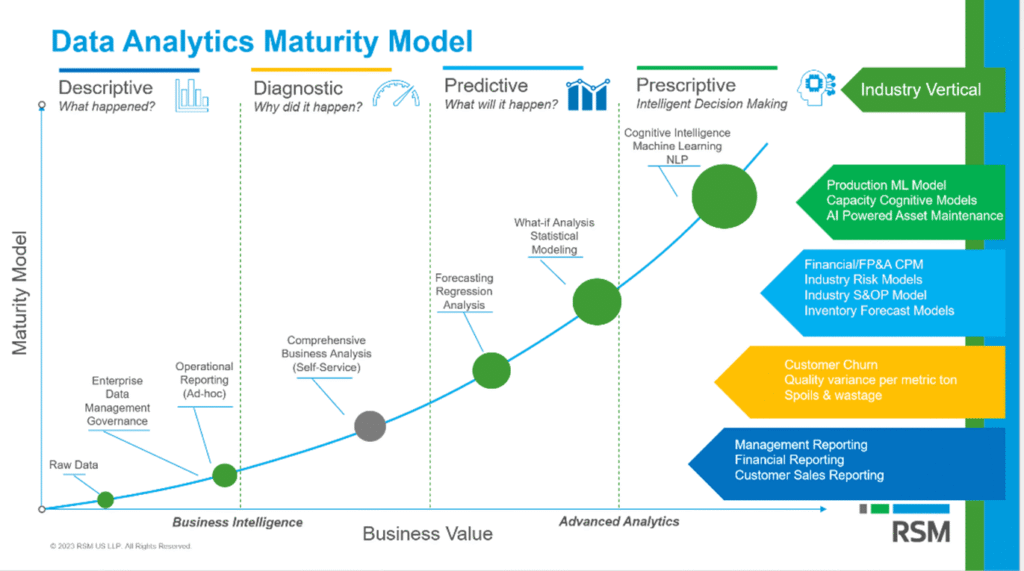
The company’s data maturity level will play an important role in setting this objective. Manufacturers that find themselves in the earlier stages of weaving data analytics throughout their operations will likely have different goals than those already using more advanced, predictive data capabilities.
Harmonizing Data Sources
Customer data, supplier data, and data generated on the shop floor all converge to create an enormous amount of potential for manufacturers looking to make their operations exponentially smarter and more efficient. But if those data sources aren’t harmonized to speak the same language, essentially, then it will be difficult to harness that information in a meaningful way.
Data-driven decision making is at the heart of the Industry 4.0 journey, and connectivity among machines, products, employees, suppliers, customers and processes across the value chain is the key to unlocking the value of this data.
Companies need to standardize various inputs, key performance indicators and other metrics so teams can manage, compare, and report on data cohesively throughout various business functions. This allows for cross-training, improvement across different manufacturing sites and standardization of best practices for broader, companywide benefit. Especially for middle market and smaller manufacturers that don’t currently compare metrics between facilities, standardization is an important step in improving data management and governance.

Jacob Friess is a Data Analytics Supervisor at RSM US LLP.