From Smart Factory to Smart Enterprise

As manufacturers digitize production, gaps in data, workforce readiness and commercial processes threaten to limit smart factory ROI.
TAKEAWAYS:
● Digital transformation in manufacturing is advancing in production and supply chain functions, but full value chain integration remains overlooked.
● Data maturity is a primary constraint preventing manufacturers from scaling smart factory investments.
● Workforce transitions are accelerating the need to digitize product knowledge, not just automate the factory floor.
Manufacturers are investing heavily in digital production. Smart factories are advancing, with connected equipment, workflow automation, and real-time performance monitoring becoming standard across many operations.
Survey data from Tacton’s State of Manufacturing report, with more than 200 global manufacturing respondents, shows that digital transformation is now a deliberate, long-term priority. Companies are modernizing supply chains, engineering workflows and production systems with clear intent. But the research also highlights a gap: while factory-level capabilities are improving, enterprise-wide integration is still uneven.
As digital production matures, the question evolves. The next phase of Manufacturing 4.0 goes beyond smarter machines to turning smart factories into smart enterprises—connecting production systems, data infrastructure and cross-functional processes so that automation delivers coordinated, enterprise-level performance.
Operational Discipline Is Reshaping Priorities
To understand where integration is breaking down, it helps to look at where manufacturers are concentrating their digital initiatives.
Across the survey data, one pattern stays consistent: manufacturers are prioritizing operational stability over expansion.
Supply chain optimization is the most consistent concern across the sector. Workflow automation and engineering efficiency closely follow.
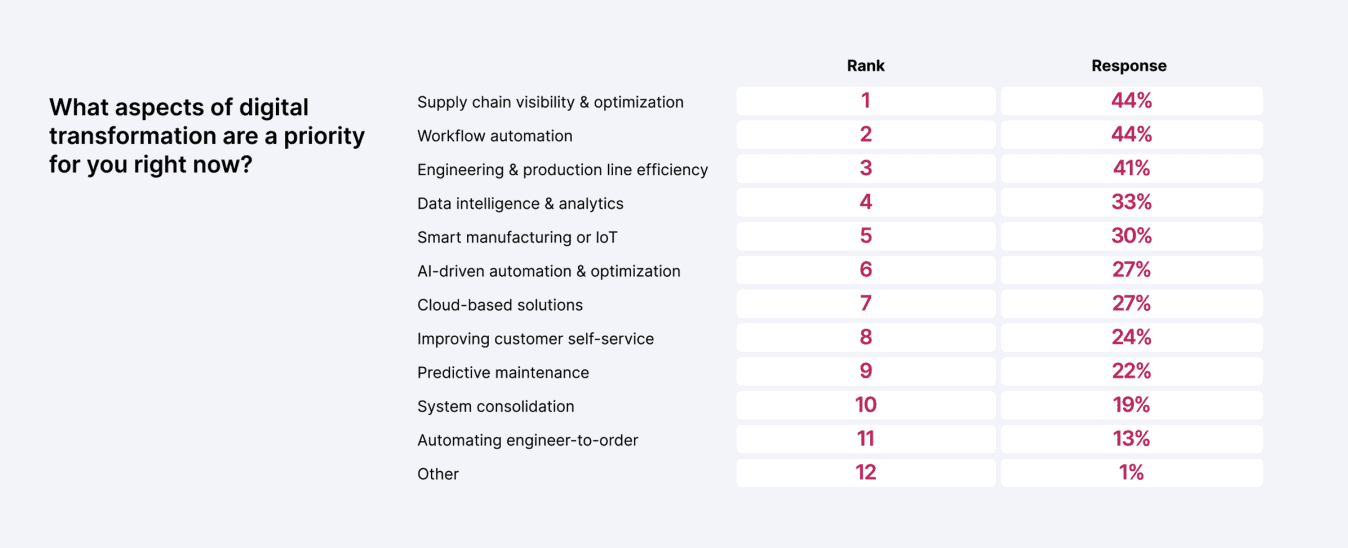
Efficiency is foundational to leading the market. This includes reducing errors, cutting costs and improving product quality. Driving revenue growth remains important, but it has slipped in priority compared to earlier years.
There is a broader mindset change. Rather than chasing rapid expansion, many organizations are strengthening core processes first by stabilizing production, standardizing workflows and improving cross-functional coordination.
There is also notable alignment across departments around reducing rework and errors, not only within production, but across engineering and sales processes, as well. Manufacturers signal growing recognition that operational performance does not stop at the factory door. Configuration decisions, pricing accuracy and process consistency upstream directly influence downstream efficiency.
In this sense, smart factory investments are part of a larger recalibration. Manufacturers are building resilience through visibility and automation, but the full benefit depends on eliminating friction across the entire value chain.
This focus on operational discipline is also reshaping how manufacturers approach sustainability.
Sustainability Is Not Just an External Pressure
Sustainability remains strategically important, but its framing is evolving. Rather than positioning it solely as a response to external expectations, manufacturers are embedding sustainability into operational performance, particularly through energy efficiency, waste reduction and process optimization.
Sustainability is becoming less a standalone initiative and more a byproduct of disciplined digital operations. As real-time monitoring and automation improve resource utilization, environmental performance increasingly aligns with cost and productivity goals.
AI Ambition Is Growing, but Readiness Lags
Artificial intelligence is widely seen as a strategic enabler of digital production. Nearly half of manufacturers are exploring AI use cases, yet only 16% report meaningful investment.
Manufacturers lack the data maturity to master AI, not the interest.
More than half of manufacturers still rely on manual reporting methods such as spreadsheets. Integrated analytics remain limited. Without consistent data governance and system connectivity, AI cannot move beyond experimentation.
Smart factory investments are increasingly centered on sensing technologies, connected equipment and real-time performance monitoring. But the value of those capabilities depends on how effectively data flows beyond the production environment.
As digital production matures, the priority shifts from deploying advanced tools to strengthening the data foundation beneath them. AI maturity follows data maturity—not the other way around.
The next phase of digital production requires closing these loops so that insights from the factory floor inform upstream planning and downstream customer commitments in real time.
A Commercial Blind Spot Impacts Operations
One of the more telling findings in the research is where transformation influence resides. IT, production, finance and executive leadership dominate digital initiatives. Go-to-market teams hold limited influence.
This matters more than it may appear.
As factories become more automated and product portfolios more configurable, quoting complexity increases. Yet 43% of manufacturers still rely on manual processes. Seventy-nine percent report recurring issues with quote quality.
The tension between speed and accuracy creates production consequences: engineering rework, production delays, margin erosion and customer frustration.
Operational excellence on the shop floor can be undermined by inconsistent processes upstream.
If smart factories are designed to eliminate variability in production, the same discipline must eventually extend to configuration logic, pricing rules and cross-functional workflows.
Workforce Transitions Add Urgency
At the same time manufacturers are modernizing production, they’re facing structural workforce change.
Thirty percent expect at least 16% of their sales and engineering workforce to retire within five years. Fewer than half feel fully prepared.
Much of the knowledge behind complex configurations, pricing decisions and engineering tradeoffs still resides in individuals. Automation has standardized routine tasks on the factory floor, but day-to-day variability (e.g., custom configurations, component substitutions, evolving cost inputs or engineering adjustments) still depends heavily on experienced judgment.
As that expertise exits, risk increases.
Manufacturers can address this by digitizing configuration rules and production constraints. Instead of relying solely on individual experience, teams receive structured guidance: automatic flags when a configuration will cause downstream issues, visibility into margin impact or validated alternatives when components change.
From Smart Factory to Smart Enterprise
Digital transformation in manufacturing is progressing. Investments in supply chain optimization, automation and connected production are already improving productivity and visibility.
But the differentiator is evolving.
As organizations mature, advantage moves from isolated automation to coordinated integration, like linking production constraints to configuration or embedding institutional knowledge into structured workflows. Sustainability, efficiency and profitability increasingly operate under the same data framework.
Manufacturers that approach transformation as a staged maturity journey—strengthening data governance, integrating systems end-to-end, standardizing processes and then layering AI—will see more durable results than those pursuing disconnected digital initiatives. M
About the author:

Klaus Andersen is Chief Executive Officer of Tacton.