Orchestrating Material Handling with AI & Automation
Smart, data-driven solutions can turn material handling limits into competitive edge by unifying virtualization, automation, AI, and secure IT/OT.
TAKEAWAYS:
● A unified digital foundation enables scalable automation and AI, delivering measurable and repeatable value across an enterprise’s domains.
● Virtualization and dynamic digital twins reduce risk, accelerate deployment, and enable continuous optimization.
● Secure-by-design IT/OT architectures are essential for orchestrating data, automation, and AI safely and at scale.
Material handling remains a significant constraint on global manufacturing. Despite deepening labor shortages, manufacturing operations still rely on the manual movement of materials, leading manufacturers to find ways to increase efficiency. While automation has helped, it hasn’t fully solved the problem. Across industries, four key barriers consistently stall progress:
- Proof-of Concept Purgatory: Many organizations attempt to modernize material handling through isolated pilot projects. Eighty percent of these efforts fail to scale beyond the pilot phase, preventing meaningful transformation.
- Lack of Orchestration: Automation is often deployed as point solutions—autonomous mobile robots (AMRs), automated storage and retrieval systems (ASRS), conveyors, and control systems operating independently—resulting in a set of disconnected processes that cannot dynamically coordinate material flow, adapt to real-time conditions, or scale effectively. Without orchestration, automation adds complexity faster than it adds value.
- Untapped Data: Data is generated everywhere but used effectively almost nowhere. It remains trapped within individual systems, limiting visibility and preventing organizations from optimizing flow, predicting disruptions, or enabling AI-driven decision-making.
- Rising OT Cyber Risk: As connectivity increases, so does exposure. Operational technology (OT) environments are now among the most targeted domains for cyberattacks. Without a structured security approach, digital transformation efforts increase risk.
Breaking through these barriers requires more than incremental improvements or point solutions; it requires a shift in mindset—from technology-first experimentation to architecture-first transformation.
The Transformation Playbook
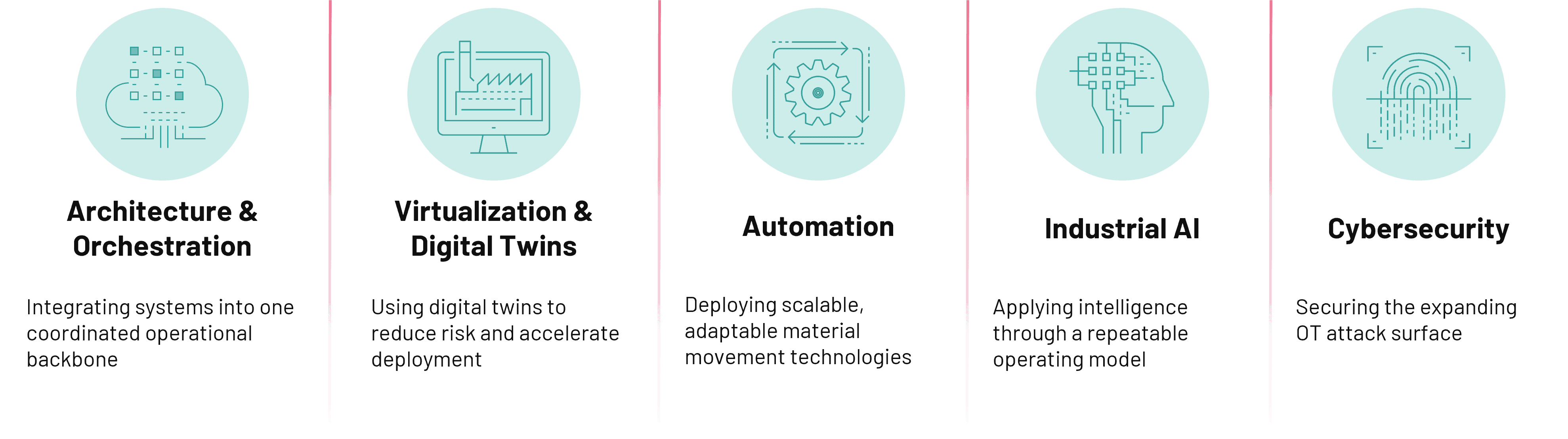
To scale effectively, organizations should design their systems as integrated, intelligent environments from the outset, ensuring virtualization, automation, and AI operate on a unified, secure foundation (Figure 1).
Figure 1: The pillars of scalable, intelligent material handling transformations
Architecture and Orchestration
Material handling systems require a well-defined architecture, orchestrated to connect systems, data, and physical operations into a unified whole.
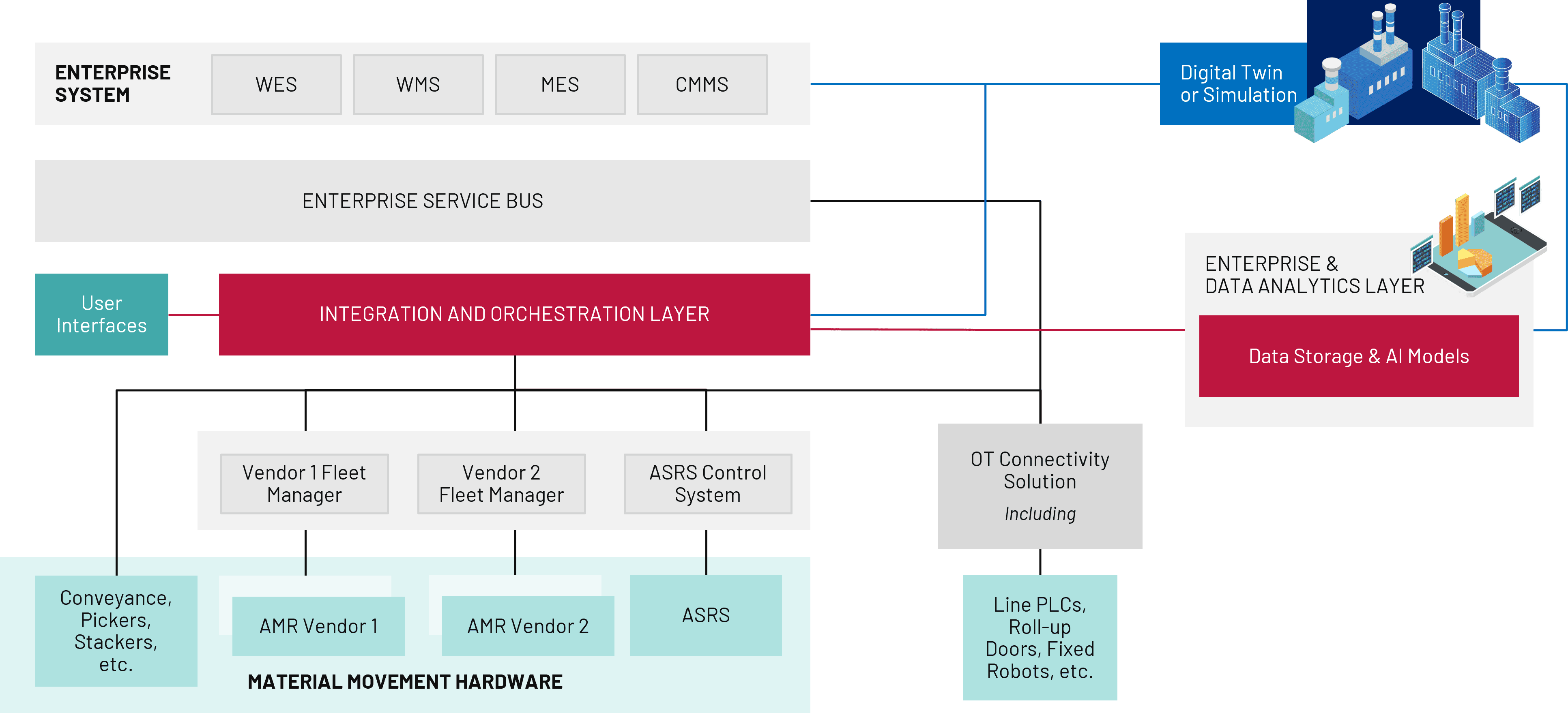
Orchestration serves as the connective layer across the enterprise, coordinating information flow between enterprise platforms and OT. It enables technologies like warehouse management systems (WMS), manufacturing execution systems (MES), control platforms, and equipment to operate as a single, synchronized environment.
A comprehensive architecture integrates this orchestration layer with enterprise systems, OT connectivity, and material movement hardware (Figure 2). This structure unlocks trapped data, standardizes interactions across sites, and establishes the digital backbone required for scalable automation, virtualization, and AI.
Figure 2: Comprehensive IT/OT orchestration addresses islands of automation
Virtualization and Digital Twins
Virtualization enables the creation of virtual representations of systems, processes, and assets. Using virtualization, manufacturers can test ideas before implementing physical changes to their operations. By virtually validating performance, integration, and return on investment (ROI), teams ensure that only scalable, enterprise-ready solutions proceed, breaking the endless proofs-of-concept cycle.
Digital twins are the primary virtualization capability. By unifying data from disparate tools and systems into a single model, digital twins create a dynamic, holistic view of operations that would otherwise remain fragmented. A digital twin supports the full life cycle of a material handling system, enabling teams to simulate scenarios, validate designs, and test automation strategies prior to deployment.
Virtualization’s value lies not in creating a perfect model, but in enabling better decisions pre- and post-deployment. Organizations that use digital twins effectively design their automation systems with greater confidence, achieve faster deployments, and continuously optimize performance. When maintained as living assets, digital twins become long‑term operational tools rather than one‑time models or proofs-of-concept.
Automation
Automation delivers meaningful performance gains only when deployed on a coordinated architectural foundation and guided by virtual design. Without orchestration and upfront simulation, automation technologies operate in isolation, limiting their adaptability to real-time conditions.
Virtualization and digital twins play critical roles in shaping automation deployment. By simulating material flows, validating system designs, and testing control strategies, organizations can ensure that automation is right-sized, properly integrated, and aligned to operational objectives.
“Organizations that use digital twins effectively design their automation systems with greater confidence, achieve faster deployments, and continuously optimize performance.”
When deployed according to validated models, automation becomes a flexible execution layer capable of adapting to changing demand, reallocating tasks, and optimizing material flow, effectively swapping fixed, siloed processes for dynamic, system-wide coordination of material movement.
The value of automation goes beyond replacing manual labor, enabling responsive, scalable operations. When guided by virtualization and governed by orchestration, automation evolves into a strategic capability that supports continuous optimization and establishes the foundation for advanced, AI-driven decision-making.
Industrial AI
AI becomes transformative only when linked to clearly defined value drivers and measurable performance improvements. Without that connection, even advanced models struggle to move beyond experimentation. Successful organizations start by defining where intelligence can improve outcomes—whether that’s throughput, labor efficiency, cycle time, or service levels—and building a structured opportunity pipeline aligned to those value drivers.
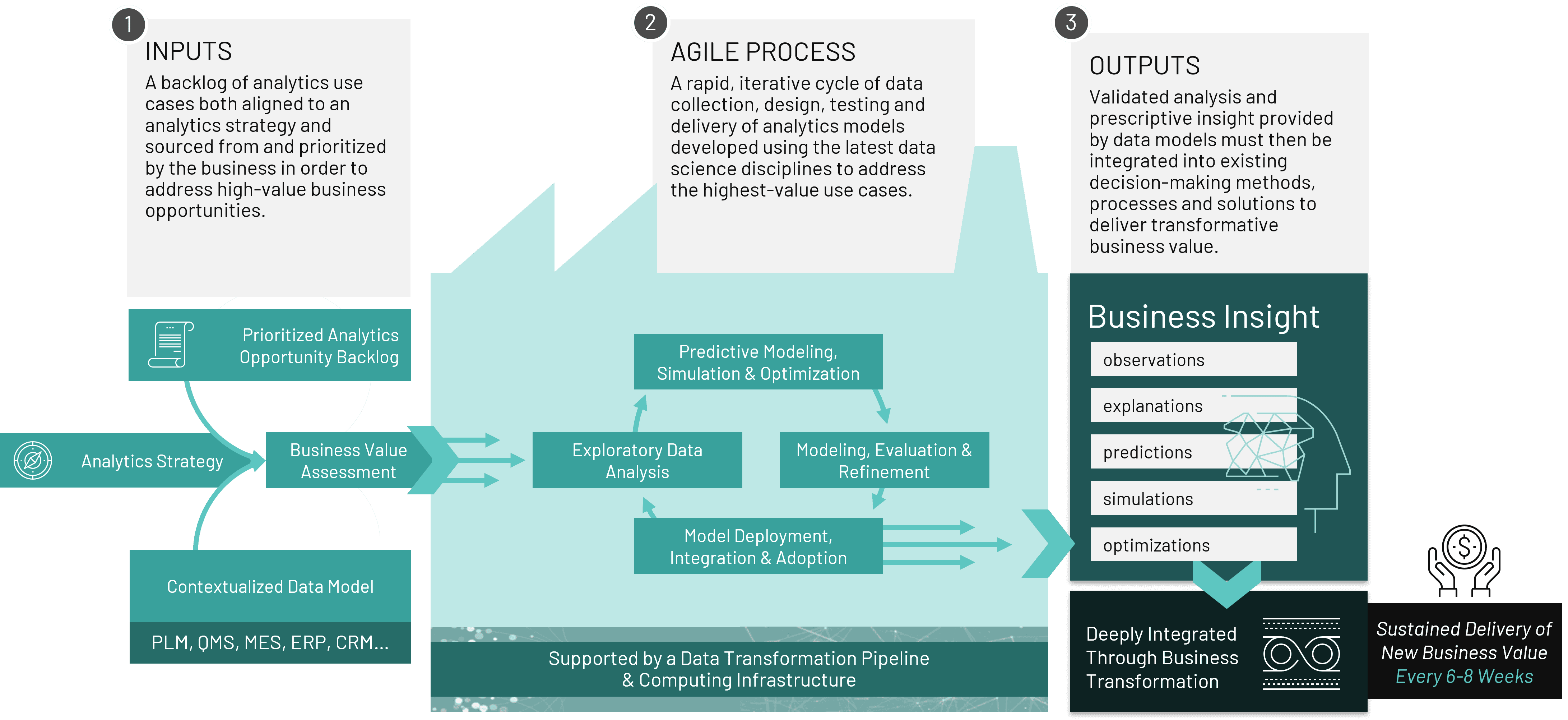
The AI Factory approach provides this foundation, using a clear set of inputs—an analytics strategy, a prioritized opportunity backlog, defined business value targets, and the data models required to support them—to fuel an agile, iterative cycle to explore opportunities, optimize approaches, develop models, and deploy solutions into operations (Figure 3). This operating model replaces perpetual, isolated experiments with a repeatable, governed pipeline capable of delivering new AI-driven capabilities every six to eight weeks. Equally important, it ensures that each deployment is tied back to measurable outcomes, reinforcing stakeholder confidence and accelerating adoption.
When organizations pursue AI through isolated proofs-of-concept, momentum slows and the value remains unclear. A value-driven operating model ensures that AI becomes a scalable capability that continuously delivers insight, optimization, and measurable business impact.
Figure 3: A self-funding, scalable analytics engine for your operation
Cybersecurity
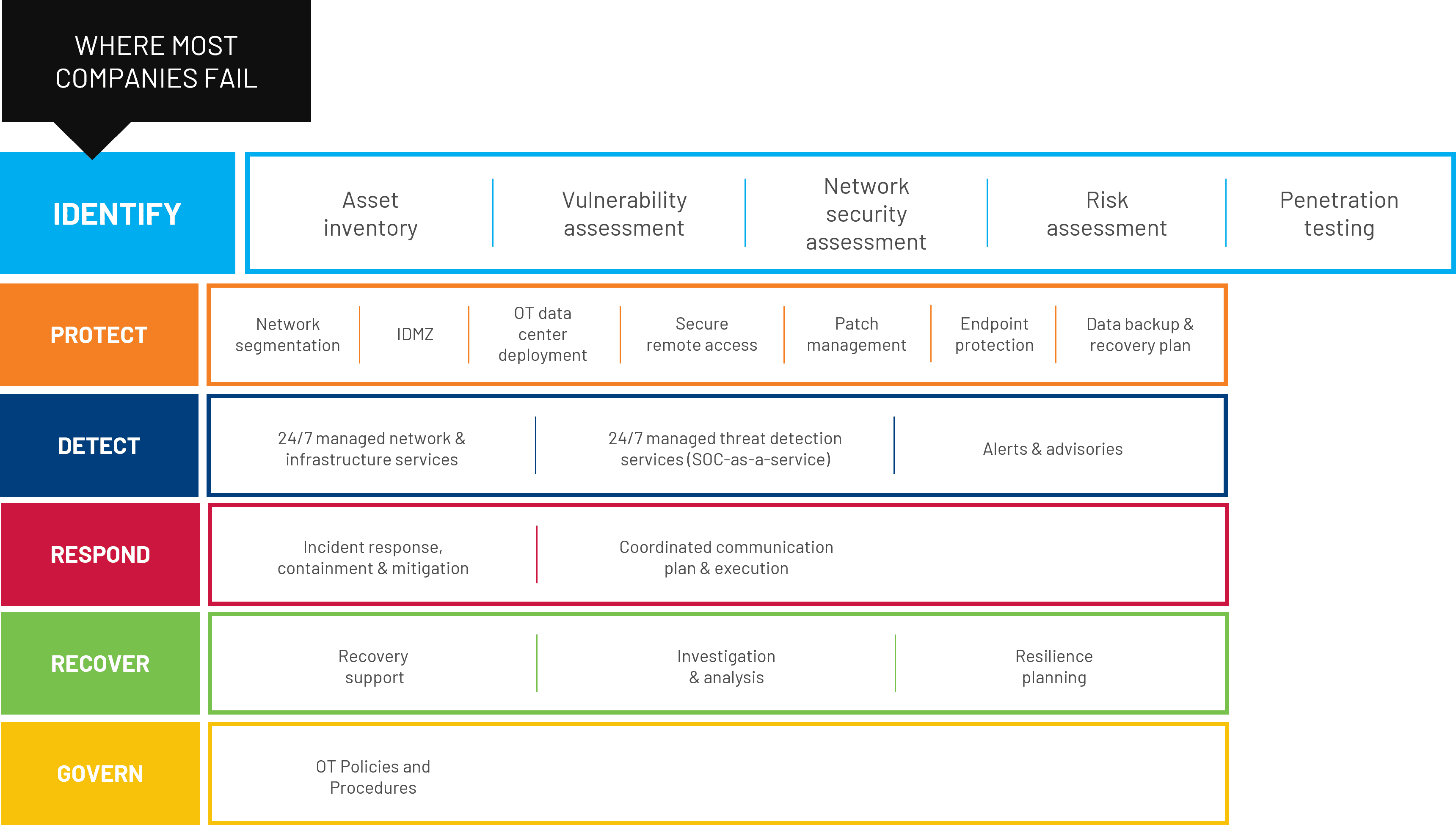
As virtualization, automation, and AI expand an organization’s connectivity, they also expand its attack surface. In modern material handling environments, a single compromised controller, AMR fleet manager, or WES can halt material flow—and production—within minutes. Thus, operational technology must be treated as a board-level risk, and a National Institute of Standards and Technology (NIST)-based framework provides a structured approach to securing industrial environments (Figure 4).
Beyond preventing disruptions, robust cybersecurity also enables orchestration and AI to scale safely. Without secure connectivity, organizations are forced to limit integrations, reinforcing the very islands of automation they aim to eliminate. Cybersecurity is not a constraint on innovation; it is the foundation that enables it.
Figure 4: NIST cybersecurity framework
A Unified Path to Step-Change Performance
Material handling challenges aren’t solved with more technology—they’re solved by designing how technology, data, and operations work together.
Organizations that achieve step-change performance gains take an architecture-first approach, where orchestration provides the foundation, virtualization reduces risk and informs design, automation executes with flexibility, AI drives continuous optimization, and cybersecurity ensures the entire system can scale safely. Together, these capabilities comprise a proven transformation playbook, but their impact depends on how they’re applied.
Successful organizations start by defining a strategy: where value will be created, how systems will integrate, and how capabilities will scale across the enterprise. Then, they use this playbook to guide execution, ensuring each investment contributes to a cohesive, intelligent material handling system. This approach moves organizations beyond isolated improvements to building a capability that compounds over time.
For executives, the question is no longer whether to invest in automation or AI, but how to design a system to unify them. M
About the authors:

Drew Cekada is Lead Principal of Retail, Warehousing & Logistics at Rockwell Automation.

Torrence Gibson is Consulting Manager of Distribution, Logistics & Supply Chain at Rockwell Automation Digital.