Rethink Opening Address: The Inevitability of Autonomous Operations
NAM CommsJuly 8, 2026
Share:
What can be done will be done. David Brousell examines why autonomous operations are becoming inevitable—and why human oversight must remain at the center.
Hello everyone, and welcome to Rethink number 22. I’m very grateful for you being here and a hearty welcome. It has been my privilege to share my thoughts with you about our digital journey since the inception of this event in 2005. With your permission, I do so again today.
***
In 1996, the president and chief executive officer of Intel Corporation, Andrew S. Grove, authored a book called “Only the Paranoid Survive.” The book’s main thesis dealt with what Grove called “crisis” points that every company and individual face.
A core tenets in the book, which later became known as one of Grove’s Laws, was that “a fundamental rule in technology says that whatever can be done will be done.”
This rule means that technological progress is essentially inexorable; adoption may be slow, even deferred or unevenly distributed, but it will take hold no matter what.
Today, we are grappling with what the roles and implications of a range of advanced technologies in manufacturing will be in the years ahead. They include AI and machine learning, humanoid robots, digital twins, cloud and quantum computing, just to name some of the most prominent and promising.
Many of these advanced technologies center on digitalization and computation. All involve data in the broadest sense across many areas important to manufacturing, including design, materials, production, people and applications about data.
But the functions and effects of these and other technologies should not be looked at in isolation. Instead, we must look at what it means when they converge into what I have called a “digital fabric”—when they are woven together to create possibilities beyond what the components may provide individually.
One such convergence now in front of us that goes to the core of manufacturing is the idea of autonomous operations. This is the subject I want to talk to you about today and why I believe very strongly that as technology accelerates, we need to ensure a human-centered approach to managing manufacturing operations of the future.
***
Let’s start our talk with a definition. Enter the Greeks. The word autonomy originates from the Greek word “autonomia”, meaning independence. It is composed of two words—“autos”, or self, and “nomos”, meaning custom or law. Historically, the term meant self-government or the freedom of a city state to manage its own laws.
The Greeks did not apply autonomia to people. That came much later, in the 1900s, when it was used to describe self-directed individuals.
In manufacturing, autonomy brings out the importance of the digital fabric as we seek to orchestrate digital and physical systems so that machines have the ability to recognize, diagnose, predict and prescribe in time and over time. But these systems, as MLC board member Dr. Jim Davis of UCLA says, needs rules, guardrails and governance. They also need to recognize when they don’t know something.
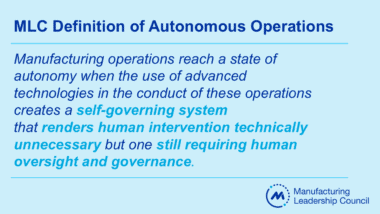
And, so, today I am introducing MLC’s definition of autonomous operations. It is this:
Manufacturing operations reach a state of autonomy when the use of advanced technologies in the conduct of these operations creates a self-governing system that renders human intervention technically unnecessary but one still requiring human oversight and governance.
***
Most technological changes or shifts don’t just appear at a point in time and take hold immediately. They undergo long gestation periods from ideation to application, a process in which experimentation leads to learning, learning leads to development, more learning occurs and the development cycle repeats itself.
We have been in such a process with autonomous operations, which can be thought of as the next step beyond automation.
Like many of its technological predecessors, the idea of autonomous manufacturing operations, also referred to as light’s out operations, dates back centuries.
The concept emerged in the late 18th century during the First Industrial Revolution. In 1785, a man by the name of Oliver Evans developed a completely automated flour mill which was capable of continuous, unsupervised production.
Other attempts at autonomy were made in the 19th and early 20th centuries. In the 1980s, General Motors, General Electric and Apple Computer, to name just three, tried their hands at it and achieved some success in specific areas but ultimately did not cross over to fully autonomous territory.
There have been many attempts at autonomous operations over the years. Those that failed or couldn’t make it to the state of being fully autonomous suffered not from a lack of aspiration or intention, but rather due to the limitations with the technologies of the times.
So, what’s changed? Why should we think we will be more successful with autonomy today? The reason is the technological stars, so to speak, have finally aligned. It is now technologically possible, due to the convergence and maturation of some of the technologies I mentioned previously, to conduct fully autonomous operations. We have the compute power, the communications bandwidth and the software technology, particularly AI, to make it happen.
And more and more, we have a growing stockpile of another essential ingredient—data—to fuel autonomy. As MLC Board member John Dyck, the CEO of CESMII, says: “Autonomy is not powered by AI alone. It is powered by trusted, contextualized, interoperable data moving seamlessly across systems.”
***
So where are we today with the trend called autonomous operations? We are traveling through a series of evolutionary stages with autonomy that have many nuances, but it is a trip that may lead to an inevitable destination.
A number of research organizations and technology providers have tried to plot out what these stages are and what the end game might look like.
Our friends at ARC Advisory Group, for example, have built a five-stage maturity model that stretches through an escalating series of automation and autonomous gradations and culminates in what the research firm calls “full autonomy”, meaning no human intervention at all.
At this point in time, though, most manufacturers are at around level three of the ARC model. ARC estimates that only 60-65 plants meet the strict criteria of being fully autonomous. And most of those that do are in the semiconductor industry.
Interestingly, sentiment among manufacturers themselves about how close we are to autonomous operations is mixed. MLC’s Industrial AI study, published in April, showed that 58% of respondents do expect factories and plants to become more highly automated by the year 2030, but that autonomous operations are a long way off, they believe. Still, 40% do see a significant degree of autonomy coming by 2030.
The reasons for these sentiments are many. Expected benefits of autonomous operations include improved productivity, safety and efficiency; better reliability; less human error; and what some call the institutionalization of operating discipline. Moreover, the prospect of elevating work to enable people to focus more on judgment, innovation, continuous improvement and managing exceptions, rather than routine or repetitive tasks is enticing.
But as maturity models suggest, there are variations in the application of autonomy. In a report recently published by Siemens, the company said: “The light’s out factory is easily implemented for simple mass production of a standard product on a fixed schedule. A completely dark factory becomes more difficult (though not impossible) as products grow in complexity and mass customization creates many product variants.”
How and where to implement autonomy internally has many considerations, but there is also an important competitive aspect of autonomy that is emerging. In an article published in April called “Light’s-Out Operations: Why Autonomous Manufacturing Matters”, EY authors Ehap Sabri and Cate Mork report that some western manufacturers have already realized significant productivity and cost benefits from autonomy, although they say the gains have come from what they call “low hanging fruit initiatives” such as automated packaging and with night shift production lines.
Manufacturers in the Asia-Pacific region, they warn, have already established a leadership position in smart factories, with industrial robotic deployment in China now accounting for 50% of the world’s industrial robot installations.
The two authors conclude by saying: “As companies in Europe and the Americas strive to close the gap, they need to recognize that achieving true light’s out capabilities will require substantial investments in infrastructure, technology and employee re-skilling. Light’s out capabilities will not emerge from incremental upgrades or off-the-shelf solutions, but by building it deliberately cell by cell, workflow by workflow, and safety layer by safety layer.”
***
And so, the race is on to achieve autonomous operations. Expected business benefits, the prospect of higher level and more fulfilling work, and the need to improve competitiveness are powerful factors driving adoption. The trend appears inexorable. What can be done will be done.
But we also must be fully aware of the challenges and risks associated with doing so. Here are some of the most significant challenges that I have put together from several sources, including an informative 2025 article in the International Journal of Technology entitled “Light’s Out: Advancements, Challenges and Prospects for Fully Autonomous Manufacturing”.
The Price Tag – Significant capital investments to implement AI-drive systems, advanced robotics and foundation infrastructure will be required. And quick ROI could be elusive.
Legacy Debt – Integrating new technologies with, in many cases, decades-old equipment will require much work.
The Data Issue – High-quality, consistent data is mandatory to fuel autonomous systems. Without it, operational disruptions can occur. And the digital fabric needs to be foundationally underpinned with the right infrastructure for data.
Cyber Risk – Increased connectivity and reliance on data will heighten the risk of cyber-attacks.
The Skills Gap – A significant effort will be required to train or hire people to manage, maintain, analyze and trust data from autonomous systems. Manufacturers need to budget for retraining. MLC research indicates few have.
Organizational Change –Autonomy is as much an organizational transformation as it is a technology transformation. It will require closer collaboration across operations, engineering, IT, data and business leadership.
Change Management – Leaders will need to manage a significant cultural change with autonomy, one requiring much change management activity.
***
While the challenges may be many this industry is no stranger to clearing big hurdles. We have done so time and time again. But we should all have a heightened sense of urgency about doing so with autonomous operations because the clock is ticking faster and faster and much is at stake competitively.
MLC’s research finding that 58% believe that autonomous operations are a long way off notwithstanding, the autonomous object in your side view mirror may be closer than you think.
A quick look at the time it took a number of key inventions of the 20th century and early 21st century to reach mass market status may suggest a re-evaluation of the timeframe for autonomous operations.
Introduced in 1876, the telephone took almost 75 years before it reached 50% penetration of households. Television, whose first broadcast occurred in 1927, became a mass market product in the early 1950s.
The IBM Personal Computer, introduced in 1981 (I was at the press conference in New York City) took 10 years to reach mass market status. Introduced in 2007, the iPhone took just three years to reach that milestone. The generative AI tool, ChatGPT, introduced in the fall of 2022, became a mass market product almost overnight, and has now reached over 900 million active weekly users.
I don’t think I need to further document the fact that technology adoption cycles have been shrinking and will most likely continue to do so.
***
So here we are in June of 2026. Autonomous operations are no longer an aspiration. Technological convergence has made it possible and, if I may be so bold as to say, inevitable. What can be done will be done.
But we retain, as people, the power to control it, to shape it, to manage it. We can limit it, be judicious in its application if we so choose. But it would be naïve, and perhaps self-defeating, to think that we can slow it down or consider it just something that is in the distant future.
We need to think and act strategically about it now, guided by our values.
Here are a few recommendations:
Human-Centricity: Whatever we do as an industry and as organizations, wherever the possibilities borne of technological advancement may take us, keep the human being in the center of your thinking. Even as AI surpasses human capabilities, we remain unique creatures, and our humanity is paramount.As former MLC board member Pietro D’Arpa of P&G says: “Automation replaces tasks; autonomy elevates human work. The future is not about removing people from manufacturing. It is about moving people from operating systems to improving, governing and orchestrating them.”
Decide the Why: Be clear, or as clear as possible, why you want autonomous operations. Keep in mind that autonomous operations is not a short-term cost play. What are your goals? What’s your organization’s balance point between business responsibility and social responsibility? And prioritize; don’t have 10 goals with autonomous. Pick three that matter.
Don’t Build on Rotting Wood: A modern, rationale technological IT/OT foundation is mandatory for autonomy. Be prepared to make investments in some of the converging technologies I mentioned. Silos are out and orchestration is in. And be careful not to overlay autonomous on a bad or creaky process. Rethink the process before you apply autonomous capabilities.
Data is the Lifeblood: Autonomous operations won’t work unless you have the right data to make it work. Ensure data is clean, organized, reliable, not fragmented, and trusted. Integrate IoT sensors, SCADA, MES, ERP and other key systems to create a reliable, real-time data stream, which is necessary for AI to make accurate decisions.
Climb the Ladder: Gain knowledge and experience with autonomy at each rung of the maturity model. You may be tempted to leapfrog, but you could be giving up important learnings.
Build Trust and Confidence: At the end of the day, success with autonomy will come down to how well you are organized around the opportunity and how well you bring your people along. Openness, transparency and empathy will be as important as vision, strategy and tactics.
I would like to conclude by citing what I consider to be an important guideline as we all travel on the autonomous journey. The guideline is part of the Asilomar AI Principles, coordinated by the Future of Life Institute, and published in 2017.
Number 10 of the Principles states:
“Highly autonomous AI systems should be designed so that their goals and behaviors can be assured to align with human values throughout their operation.”
I think this is wise guidance. I hope you do, too.
Have a great Rethink, and, remember, imagine a better future! Thank you.M
Photos by National Assoc. of Manufacturers
Members-Only Content
Please sign in with your member email to view this resource.
Your privacy matters
We use cookies to operate this site, remember your preferences and understand how visitors use it. By selecting ?Accept cookies,? you agree to our use of cookies as described in our Privacy Policy.