The Need to Accelerate Industrial AI Adoption By 2030

AI will become a key player in driving manufacturing competitiveness in the years ahead.
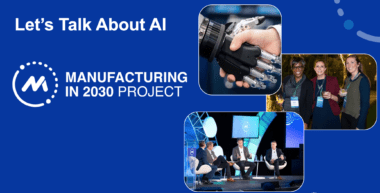
David R. Brousell, Co-founder of the NAM’s Manufacturing Leadership Council, called on all manufacturers to accelerate their understanding and use of new Artificial Intelligence (AI) technologies in his opening speech at the MLC’s latest Manufacturing in 2030 event, Let’s Talk About AI, in Nashville, Tenn., this morning.

David R. Brousell, Co-founder, MLC
“The stakes for our industry and our country couldn’t be greater as our economy becomes increasingly digital,” asserted Brousell. “Global competition for dominance in AI is underway, with manufacturing as a key player in the race. Our competitiveness as an industry at home and abroad will increasingly be defined by AI expertise, application, and experience – and in a trusted and responsible way.”
Technologically, he noted, AI is finally coming into its own after a long development period and researchers now estimate that the value of the global AI industry will rise rapidly from $93.5 billion in 2021, to a substantial $1.8 trillion by 2030.
AI is also a pervasive technology, he continued, meaning that it will be incorporated into many other technologies including semiconductors, software applications and platforms, and communications equipment. It will increasingly power the operation of front-office applications, ERP, PLM, MES, CRM and other key operational applications. Robotic systems, too, will increasingly be guided by AI.
And although only 9% of respondents to a recent MLC study said that they saw AI and ML as a game-changer for the industry today, by 2030, 53% said that they believed it would indeed become a game-changing transformative force.
Citing a U.S. Patent Office report from October 2020 that stated, “AI is poised to revolutionize the world on the scale of the steam engine and electricity”, Brousell stressed that’s why manufacturers now need to better understand how AI may shape how they run their factories and plants, how it will influence their workforce strategies, what business benefits may attend AI use, and what challenges the industry must overcome to realize its potential in the years ahead.
However, “as with any important technology,” he added, “let alone one as unique as AI, there will be a learning curve replete with twists and turns.”
One of those twists is the fact that AI remains a controversial technology. Some see it as an existential threat to humanity; others see it unleashing a new wave of productivity and efficiency and enabling people to have better and more rewarding business lives.
Brousell also believes that AI’s unique ability to learn, and what that ability implies for predicting machine and operational patterns and behavior, qualifies it to be “in a special place among all of the technologies associated with digital transformation.”
“I can’t think of another technology that we have employed in our factories and plants,” he added, “that requires us to ask the question: do we need a code of ethics for AI use?” According to recent MLC research, he noted, 75% of manufacturing executives already believe a code of ethics will be needed in the years ahead.
Nevertheless, predicted Brousell “AI is here to stay”, and that its influence will only grow in operations, in the workforce, in the interactions across supply chains, and with customers and partners in the years ahead.
“AI”, he concluded, “is truly a force to be reckoned with” for the future of manufacturing, and manufacturers now need to act with urgency to accelerate its adoption to drive competitiveness in the years ahead.