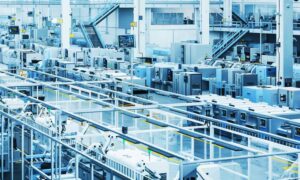
Using AR to Transform Manufacturing Operations

How manufacturers can optimize their productivity, quality, and efficiency with augmented reality.

With the advent of Manufacturing 4.0, most industrial companies are now recognizing the need to modernize their production and quality control processes, and to integrate innovative tools into their strategy. Digital solutions have long been used for the design and simulation of manufactured products. However, M 4.0 technologies are still not widely deployed in manufacturing despite the significant gains they bring in productivity, quality, and efficiency of operations in industrial markets that are increasingly competitive and subject to strong cost pressures.
The reason for limited deployment is often the lack of knowledge of the relevant use cases illustrating the ROI digital tools can generate. This has been the case for many digital tools (IoT, artificial intelligence, robotics, etc.) appearing in production or maintenance centers and within quality processes for some years now. How can manufacturers distinguish between projects that have never gone beyond the POC stage and those that have really been deployed and proven to bring value?
Several gains are at stake: reduction of cycle times, right the first time (reduced levels of non-conformities), reduction in costs due to defects detected too late in the process, improved traceability and digital continuity, and even increase in competence and comfort of work for operators.
Production and maintenance operations have everything to gain by integrating transformative technologies such as augmented reality. AR is particularly relevant for products with complex and variable configurations as found in many industries. It is also a suitable solution for all sectors with similar characteristics and constraints of MRO applications.
The estimated market size for AR applications was estimated to be $15.2B in 2021, and it is forecast to grow to more than $90B by 2028. This shows clearly that companies are investing heavily in this transformative technology, but where is it being applied and how can you make best use of it? The following four examples show how AR can be applied to common manufacturing processes to transform how operations are executed.