Dialogue: Pioneering an Industrial Revolution at Bosch
Frederic Boumaza,
Vice President at Robert Bosch and General Manager of the company’s ML
Award-winning Mondeville plant in France, is piloting advanced technologies, collaborative structures, and new business models to
support the German company’s Industry 4.0 transformation to a globally
connected manufacturing enterprise.

“I don’t think there is a department or part of the company that has not
been transformed or touched by Industry 4.0.”</em ></span >
Frederic Boumaza, Vice President, Robert Bosch France</em >
Q: What initially motivated Bosch to become involved as one of the pioneering companies behind the whole idea of Industry 4.0?
A:
Bosch started working on industry 4.0 very early, mainly because the company identified, really quickly, the meaning and importance of data to the future of the industry, and that we could use data and new data management approaches to improve our own production systems, and then to create new services based on this data. The vision was that, in the future, everything will be connected. Basically everything from the product, to the manufacturing equipment, to the
people working in the plants, to the customer side, to the supplier side, everything will be connected by data. Because we were able to make these connections, or at least, to define how we could make connections based on new processors new data capture systems, and sensors, etc., we were pretty sure from the beginning that this really is a revolution that would lead to an
interconnected world of manufacturing.
Q: Today, after a few years of pioneering Industry 4.0 ideas, has your understanding changed?
A: Many of the original ideas are the same, but over the years more elements have
emerged. When we look at what we have implemented over the last few years, and
what we still have to implement in the next few weeks, it’s clear that it’s a revolution. It’s much more than just an evolutionary step. We also learned that it’s not just about technology, it’s also about a change of mindset and the way people are working. Technology is important, of course, because it allows connection, communication, and the use of data in machines, and across the
industry, but also between people too. Today the employees, and the way they work, are more connected and informed, and this communication makes us much more agile, much faster. So Industry 4.0 applies as much to the people as it does to the products, the processes, or the machines.
Q: What key lessons has Bosch learned about deploying Industry 4.0?
A: For Bosch, overall, I think one of the key learnings is that data is clearly “the new oil”. That means that you can gain a lot of things – savings, improvements, learnings – based on the data you collect, especially from the manufacturing process, and then you can transfer that
knowledge to the improvement of products, to services to our customers for their products, or to services to our suppliers for their machines and for their supply chains. And it’s a continuing process. There’s not really a target or an end-state for Industry 4.0. You can always continue to develop and discover new things. We manufacture many different products and a wide range of services, and now we are moving to become an even more data-driven company and a major leading company in this connected world.

“We were pretty sure from the beginning that this really is a
revolution that would lead to an interconnected world of manufacturing.”
Q: How has this approach transformed Bosch as a company over the last few years?
A: I don’t think there is a department or part of the company that has not been transformed or touched by Industry 4.0, because the connection of all the systems, and the whole ecosystem around them, is a key success factor in Industry 4.0. We try, in every single product, process, and
department to collect more data, to analyze that data, to analyze it very fast, and to learn from the data about how to improve things. Today, this kind of improvement loop is available in almost all departments in the company, so the whole company is involved in the transformation.
Q: Has the organizational structure of
the company also changed as a result?
A: We realised a few years ago that all our employees need to work in a more collaborative way, so we have developed a specific platform to help connect our people faster. We call it Bosch Connect. We also realised that if you want to be fast, you shouldn’t have too many levels of hierarchy to slow you down. So we work in a kind of matrix, where there are some hierarchical structures in certain functions, but also systems that work across the whole value stream so
people can get the information they need quickly and without having to go through all the hierarchical levels. For example, in terms of achieving a flatter organization, for a lot of projects we now work in a “podular” structure. So, not in a kind of pyramid organization, but by creating teams, or pods, with people from multiple departments with different expertise who can
work together on projects much faster. They could be from manufacturing, R&D, development, supply chain, or IT, and they could involve Vice Presidents or front line employees. As these teams are mostly independent of any hierarchical constraints, they can connect and act in a much more agile way and really focus on the results.
Q: What approach are you using at Bosch to drive Industry 4.0 technology deployment and transformation?
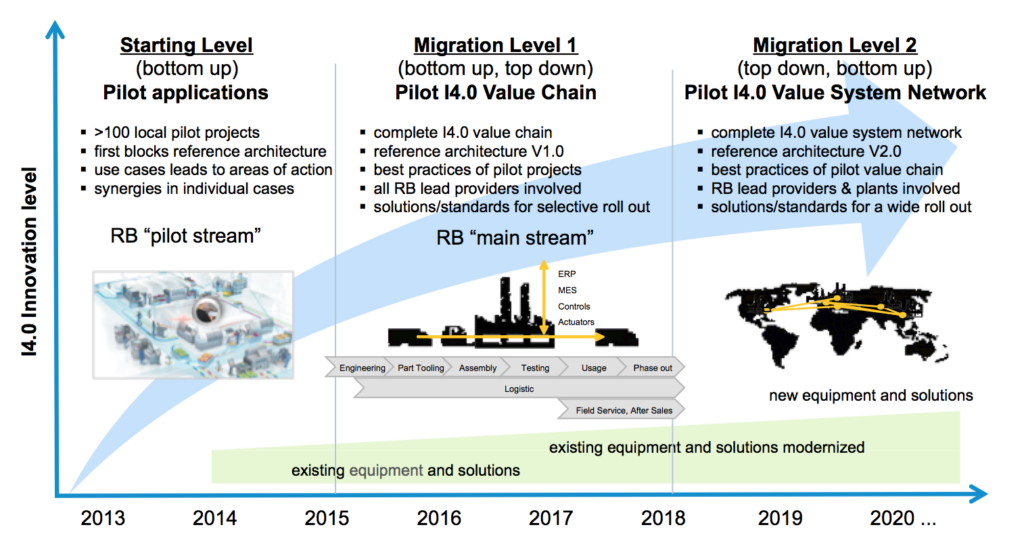
A: Basically there are three levels. The first one is bottom up. So we have created over 100 pilot projects in different plants using different technologies in different ways. These could involve cockpit dashboards to gather multiple streams of data, augmented reality glasses to help employees on the plant floor, or IoT data to drive predictive maintenance and quality, which is one of the things we’re doing at the Mondeville plant in France for the electronics sector.
The second level is both bottom up and top down, where we evaluate the best pilot applications and consider how these can benefit the complete value stream for new products and processes. This is when we introduce aspects of standardization. We don’t want to have 280 plants around the world all developing a patchwork of local applications. We want to standardize on the best
ones and develop them across the whole company. So the third level is to complete the global value chain and have very centrally standardized, interconnected systems that we can roll out worldwide, but that can still be adapted to local needs. You need to have that coordination worldwide to be efficient. This approach gives local teams the chance to pilot and develop their own ideas, because many of them have very good ideas. You then assess their proposals, and if the solution is good and it works, it becomes a standard and is transferred to all the other plants. It’s a framework in which creativity can still develop but delivers acceptable, standard solutions that drive efficiency for the whole company.
Robert Bosch: Industry 4.0
Implementation Strategy

Q: How does the ML Award-winning Mondeville plant in France fit into this
process?
A: The motivation behind the Industry 4.0
transformation at Mondeville is really simple. From a global perspective, France
is a high labor-cost country, so if you want to create a competitive business,
controlling your costs is one of the major challenges. We saw Industry 4.0
solutions as enablers to improve our costs by improving our productivity, our
quality, our production efficiency by reducing downtimes, by optimizing our
resources, and by reducing our stock costs. The key to all that is to have
real-time data throughout the production process.
Q:
How did you begin your Industry 4.0 journey at the Mondeville plant?</i ></strong >A</strong >: We really started in 2012, first with different connected
logistics and monitoring systems and then with our production data. So we began
with what we call our pocket line services, a multi-service mobile application
for the plant floor. This provides very clear and easy to understand information
that you need to drive manufacturing and is also available on big screens on the
plant floor for all the employees to see. Six years later, you may not think
this is rocket science, but at that time, it was a major change for us and for
our employees and was really the start of the revolution. Then we started to
connect all the data from the value stream – so supplier data, logistics data,
production data, and delivery data. Connecting the value stream was really
important for us and had to be done step by step. We also developed some local
production systems to support people doing their activities in the right way,
and RFID solutions to optimize the work of employees in the logistics area. Then
we moved to the next step – adaptive manufacturing. So we were able to use all
the data we were collecting about the production, the products, and the people,
and use it to adapt our processes and testing for both big lots and small lots
too. The next step was to make our products smarter, so some of our products now
save data about their own production history and the environment at the time
they were produced so we can analyze it to make further improvements. We’ve also
introduced many other new technologies such as 3D printing, collaborative
robots, local positioning bracelets for operators, augmented reality glasses for
quality control, and automatically guided vehicles for logistics. In the end,
it’s not just any one technology that makes the difference, but the benefit of
all the technologies working together on a regular basis to make the plant more
efficient, adaptable, and competitive. And that will help to assure the future
of these kinds of plants in high labor-cost countries.
Robert Bosch, Mondeville Plant:
Industry 4.0 Roadmap</b >
</img src=”http://nammlc.wpengine.com/wp-content/uploads/2018/05/Chart-2-Robert-Bosch-Mondeville-Plant-Industry-4.0-Roadmap.png”>
Q: How important has cultural change
been to driving this initiative? </i >A:</strong >
Very important. We aim to keep everyone involved. For example, we have two
innovation days each year in the plant, similar to an internal exhibition, to
show all our employees what kinds of solutions we’re working on, why we are
doing this, and so they can try some of the new solutions for themselves. Not
just the management and the engineers, but right down to the employees on the
shop floor. We’ve also installed what we call “student incubators” at the plant.
This additional workforce is made up of students aged 20 to 22 years old, who
come in one or two weeks a month to work on new kinds of solutions. The exchange
of information between our experienced employees and the students can give us
new insights and help inspire them both. And I think the third enabler is that
we pilot a lot of new solutions directly on the plant floor – like collaborative
robots in production or automated guided vehicles in logistics – so users can,
by trial and error, learn how it works and adapt it if they need to. We want to
give them enough autonomy to feel part of the transformation process.
Q: What benefits have you seen at
Mondeville as a result of this transformation?</i ></strong > A: We’ve delivered on a number of KPIs.
For example, stock deviation has been reduced by 99%, overall equipment
efficiency has improved by 3-5%, quality testing in some areas has improved by
over 20%, and daily reports that used to take a couple of hours to prepare, now
take only 30 minutes. Overall, I’d say that the plant’s productivity has
improved by more than 15% over the last three years, based on better production
transparency and being able to analyse all the real-time data.
Q: How has the Industry 4.0 journey
also helped you pursue new business models at the plant?</i ></strong > A: When I took over responsibility in
2015, Mondeville was entirely focused on the automotive sector, producing
millions of the same parts and products every year. The challenge was to
transform and reshape the plant to address new electronics markets in areas like
consumer electronics, home electronics, and in particular, to open up to the new
world of connected objects. But to address these new markets, we had to rethink,
again, our manufacturing activities because we now had to produce small lots,
and to very specific customer demands, which is a more volatile business. To do
that, we had to be more agile and much more flexible in our production and
logistics, so we had to use Industry 4.0 solutions. Without them, we would never
have had the right tools to address the new markets. Today, instead of just
producing what we are told by a central point, we have introduced new levels of
adaptability, more customised design approaches, and even commercial teams so we
can actively seek new business opportunities and deliver a wider range of
services to our customers. Today around 25% of what we do is serving
non-automotive customers and we can see that new business continuing to grow in
the future. So Mondeville is no longer just an automotive electronics plant,
it’s also becoming a pilot plant for Industry 4.0 and a new kind of
intrapreneurship across the company’s manufacturing activities.
Q: Bosch aims to achieve €1 billion in
gains and €1 billion in new revenues by 2020 as a result of its various
Industry 4.0 initiatives around the world. How far have you come to reaching
that goal? </i >A:</strong >
I can’t give you a precise figure regarding what we’ve achieved in billions or
millions of Euros, but what I can say is that the vision was the right one. On
one hand, we have made major production improvements and quality improvements
that have brought us a lot of savings across all our production activities. So
we are able to industrialize our products smarter, faster, and make more with
the same resources. We have increased our level of efficiency. That’s a major
contribution to this vision of a billion Euro savings and revenues. On the other
hand, we have also developed a lot of Industry 4.0 tools and applications that
we can provide as services to suppliers and to customers. That’s also generating
new revenues.
“To rapidly implement new solutions and key enablers for Industry 4.0,
you have to rethink the organization to be much more agile, across the whole company.”
Q: What do you see as the biggest
opportunities for manufacturing over the next five years? </strong >
A: I’m really interested in what we will be able to
achieve with all the data that we are collecting. First, what exactly is the top
limit of efficiency that we could reach in the production of products using all
this data? That’s something that I find very exciting. Second, based on all this
data that we will collect and analyze, how can we not just make production more
efficient, but also deliver new services, so we are not just producing products,
but creating new business models based on the data that we will have. I am
convinced that, in a connected world, in a fast-changing world, you will not be
able to achieve competitive success without Industry 4.0 solutions.
Q: What challenges still keep you awake
at night? A: </strong >Speed is one. We know that we are already well advanced on this journey
with the implementation and transformation to Manufacturing 4.0. But we also
know we would like to be faster, even if we are on the right track. Driving the
business is the kind of race we have to win – both personally, and for the
company we are working for. The necessity for high speed is a major challenge
that I see for us, and one that I have to deal with every day. You have to be
very fast in every decision and in the implementation of new solutions and
improvements. Also, we need to think about the organization. We rely on
employees working in our organization in certain ways, with certain attitudes,
and with business processes that may have been in place for many years. But to
rapidly implement new solutions and key enablers for Industry 4.0, you have to
rethink the organization to be much more agile, across the whole company, in
order to be able to profit from those solutions in a faster way. That can also
be a challenge.
Q: So what key leadership skills will be
needed in a future manufacturing enterprise? A:</strong >
Flexibility is one of them. As a leader, you will not be able to describe
exactly what the journey to Industry 4.0 will look. You will have to adapt
yourself to that journey and support new employees to adapt as well. Leaders
also need to be more future-oriented, to be able to develop and explain their
vision, and to create some excitement around that to motivate their teams.
Finally they need to work in an agile way, not to be limited by traditional
levels of hierarchy, but to accept that, to be fast enough, you have to create
expert teams and give them the right levels of autonomy to succeed.
Q: Finally, if you had to focus on one
thing as a watchword or catchphrase for the future of manufacturing, what
would that be and why?</i ></strong > A: I think it’s the ability to make more, and
better, with the same resources, across the whole value stream. I don’t just
mean producing products and parts. I mean everything that comes before and
everything that comes after manufacturing, along the entire value chain – from
the idea, to the supplier, to production, to delivery, and to service. One other
point, perhaps especially for small and medium companies. There is a saying:
“What’s important in life is not the cards you get, but what you do with them.”
Every leader, every manager, every employee, every company, no matter what size
they are, can now decide how they want to play their game towards Industry 4.0.
At Bosch, we decided to play that game in our own plants first, then to create
solutions for customers, and then to become a leading developer of new kinds of
connected systems.
Q: So do you think the future of Industry
4.0 is still a gamble, in some ways? A:</strong >
No. It’s not a gamble. It’s not about chance. It’s a race. And you have to aim
to win. M
FACT FILE: Robert Bosch GmbH
</span >– Location: Gerlingen/Stuttgart, Germany
– Business Sector: Automotive, Appliances, Power Tools,
Engineering, Electronics – Revenues: $95.5 billion (€78
billion) in 2017 – Net Profits: N/A (Unlisted Company)
– People: 402,166 Employees
– Market Presence: 60 Countries
-Production: 280 Production Sites Worldwide
EXECUTIVE PROFILE: Frederic
Boumaza</span > </strong >– Title: Vice President, Robert Bosch, France; General
Manager, Bosch Mondeville Plant – Nationality: French
– Education: Master’s Degree in Engineering, Ecole Nationale
Supérieure d’Ingénieurs, ENSIAME, Valenciennes, France; Executive Course in
Innovation and Financial Management, University of California Berkeley, Hass
School of Business. – Languages: French, German, English
– Previous Roles Include: – Director,
Manufacturing & Planning, Electric & Hybrid Vehicles, Bosch Germany
– Senior Manager, Office of the Board of Executive Management,
Bosch Germany – Manager, Quality Department, Bosch France
– Manufacturing Engineer, Gasoline Systems, Bosch Germany
Other Industry Roles and Awards: – 2018
Manufacturing Leadership Award, Industrial IoT Leadership
– 2017 Plant of the Year Award, L’Usine Nouvelle Magazine,
France – Member, Association Régionale de l’Industrie
– – Automobiles (ARIA), France