Embracing the Industrial Intelligence Era of Manufacturing

The next era of manufacturing will be won by companies that strategically plan, architect and know how to derive value from their technologies.
KEY TAKEAWAYS:
- Manufacturers must connect people, process and technology to turn data into real operational outcomes.
- Digital and AI investments underperform without integration, governance and a scalable operating backbone.
- Success requires building across five pillars that enable sustained, measurable transformation.

Something fundamental is shifting in manufacturing. Technologies are getting smarter, data is everywhere, and AI is no longer a pilot program; it is running quality checks, adjusting processes and flagging failures before they happen.
But the real transformation is not the technology itself. It lies at the intersection of people, process and technology, and most manufacturers are still struggling to connect those dots. They have invested in digital, run pilots and constructed dashboards; yet for many, the returns have not matched the investment, nor have they measured up at scale.
That is not a technology problem; it is a planning and integration problem. This is the central challenge of the Industrial Intelligence Era: the next phase of manufacturing where operations don’t just collect data, they act on it. We are entering an era where systems don’t just monitor; they sense, decide and either respond autonomously or surface recommendations to the right person at the right time.
The manufacturers that succeed will not be the ones with the most technology, but those who figure out how to make everything work together and achieve measurable, sustainable outcomes.
From Transformation to Activation
Over the past decade, the manufacturing industry has poured billions into digital capabilities: manufacturing execution system (MES) platforms, Internet of Things (IoT) sensors, data lakes, analytics tools and connected assets. Too many organizations made the investments to build a foundation but did not utilize it fully. According to the 2026 State of Smart Manufacturing Report, only 43% of data collected by organizations is used effectively. Until this gap closes, digital solutions will underperform their potential.
The primary barrier is the lack of connectivity between people, process and technology. Without integration, data is easily siloed, ungoverned, or lost; insights remain trapped inside dashboards that quickly fall out of use; and promising pilots fail to scale.
“We’re entering an era where systems don’t just monitor; they sense, decide and respond autonomously or surface recommendations to the right person at the right time.”
It is a consistent pattern: a team proves value locally, but the capability never expands. Why? Because there is no backbone to plug it into; no infrastructure to scale it; no workforce trained to sustain it; and no governance structure holding anyone accountable for scaling the value.
This is the trap that most organizations experience today, and it illustrates why transformation alone is not enough. The next phase is activation: embedding digital capabilities into how the operation actually runs.
Activating the Industrial Intelligence Era
Manufacturers making meaningful progress are not chasing isolated technologies. They are building across five interdependent pillars that empower people and anchor transformation in a scalable, data-driven operating model (Figure 1).
Figure 1: Five interdependent pillars that are key to successful transformation
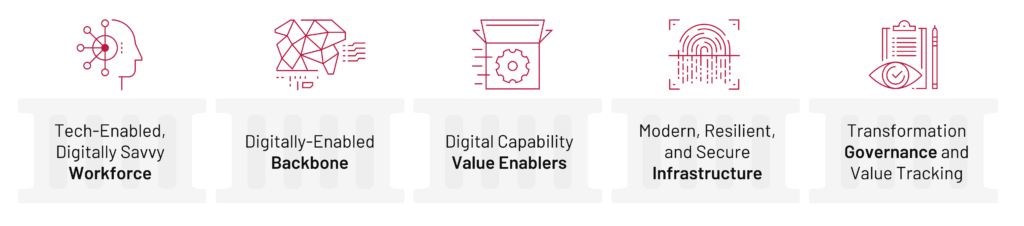
- A Tech-Enabled, Digitally Savvy Workforce
Technology does not create intelligence; people do. If people are written out of digital transformation and AI or included as an afterthought, technologies will not stick. Yet, companies often underinvest in workforce enablement.
An intelligent factory’s workforce is elevated, not replaced, by machines. The right technologies mean operators can evolve from watching screens and turning wrenches to managing exceptions and validating system decisions. Engineers can focus on optimization rather than firefighting. Maintenance can move from reactive break-fix to predictive strategies driven by real-time asset health data.
Realizing this shift requires deliberate investment in training, digital literacy and change management. Without it, even advanced technologies fail to deliver value. - A Digitally Enabled Backbone
This is the operational nervous system, integrating MES, production monitoring, maintenance management and enterprise data. Without this backbone, an operation is merely a collection of islands of automation, with people, spreadsheets and tribal knowledge filling in the gaps. With it, you have a coordinated, data-driven operation where decisions are based on real-time, trusted data across the enterprise. Without this foundation, nothing scales. - Digital Capability Value Enablers
Modern digital capabilities can fundamentally change operations: advanced process control (APC) can dynamically tune production; AI-powered vision systems catch defects invisible to the human eye; digital twins allow teams to test changes virtually before touching the real process; and intelligent autonomous mobile robots (AMRs) move materials without forklift drivers. These examples illustrate the kinds of value enablers available across manufacturing environments, rather than a prescriptive checklist for every operation.
These are not standalone solutions, however. Their value depends on integration into a broader digital ecosystem. Without that connection, they remain isolated pilots rather than drivers of enterprise value. - Modern, Resilient and Secure Infrastructure
Infrastructure underpins everything. OT networks must be architected for uptime, segmented for security and designed to handle the data loads that AI and analytics demand.
Cybersecurity, edge computing, data infrastructure and hybrid cloud connectivity are not optional; they are foundational to sustaining performance, scalability and resilience. Without them, transformation quickly reaches its limits.
For more on this topic, check out this article: Resilient IT/OT Architectures: Protecting Against Cyber and Operations Risk - Transformation Governance and Value Tracking
Sustained progress requires committed leadership and a relentless focus on value.
Successful organizations establish governance structures with clear ownership, decision rights and accountability at every level, from enterprise to plant. These transformations require cross-functional alignment across operations, IT, OT, finance and the business.
Equally important is rigorous value tracking. Outcomes must be measured against business objectives, not activity metrics. Too many transformations lose momentum due to a lack of visibility into results. The companies that win are the ones that build value tracking into the program from day one, review it regularly and hold leaders accountable for delivering results.
Governance ensures the other four pillars remain aligned, scalable and outcome-focused.
The Gap Is Widening
The distance between the leaders and the laggards is growing. Some manufacturers are integrating across these five pillars, building coordinated capabilities that compound over time. Others are struggling to align their workforce, technologies, infrastructure and governance structures in the face of mounting external pressures. Experienced operators and engineers are retiring and taking decades of knowledge with them; supply chains remain unpredictable; products are becoming more complex; and cybersecurity threats are escalating. Companies that have not built across all five pillars will find themselves with systems that generate data but do not drive outcomes and they will fail to remain competitive.
The Crossroads Is Now
The transition to the Industrial Intelligence Era is already underway. It does not require a complete reset to get started; it simply requires discipline.
Manufacturers must integrate their digital backbone, deploy high-value capabilities, modernize their infrastructure, enforce governance and most importantly, invest in the people who will run and optimize the operation every single day. Each pillar reinforces the others. Weakness in any single pillar limits the value of the rest.
The Industrial Intelligence Era will reward companies that move beyond experimenting with technology and start using it across all five pillars in a coordinated and sustained way. The question is not whether your factory will need to become intelligent, it is whether you will be ready when it does. M
Author bio:

Stephen Birtsas is Principal & Global Practice Leader, Consulting & Supply Chain, Kalypso.