
The Scaling Constraint: Trusted Operational Information

As manufacturers scale analytics and AI, hidden OT technical debt often undermines trusted operational information.
KEY TAKEAWAYS:
- OT technical debt often remains hidden until operational data must scale across sites, systems, and business functions.
- Preservation of operational context and the consistent use of standardized definitions are foundational to scaling Manufacturing 4.0 initiatives.
- Reducing data friction requires governed definitions, operational context, and scalable information models, rather than control-system rewrites.
Manufacturers rarely discover information-scaling problems when a machine fails; they discover them when comparable plants produce different answers to the same performance question. For example, one site reports higher uptime than another. Both teams trust their numbers, yet the comparison breaks down because each applies different assumptions for startup losses, blocked conditions, or external constraints.
That disconnect is often an early sign of operational technology (OT) technical debt: accumulated operational choices that shape how performance data is defined, calculated, and interpreted. Calculations are implemented where they are easiest to maintain, operating-state definitions evolve locally, and exceptions understood by operators are not always captured in the data. While these decisions infrequently affect day-to-day production, they cause challenges when information must support enterprise key performance indicators (KPIs), analytics, artificial intelligence (AI), and cross-site decision-making.
Research from the Manufacturing Leadership Council (MLC) and Rockwell Automation shows manufacturers are increasingly focused on scaling analytics, AI, and operational intelligence across the enterprise. As those initiatives expand, inconsistencies in definitions and operational context become more visible. What works locally becomes difficult to compare, aggregate, or reuse across facilities.
“Manufacturers that achieve greater value from analytics and AI focus first on reducing ambiguity in the information they already possess.”
Information can only scale if its meaning remains intact as it moves beyond the plant floor.
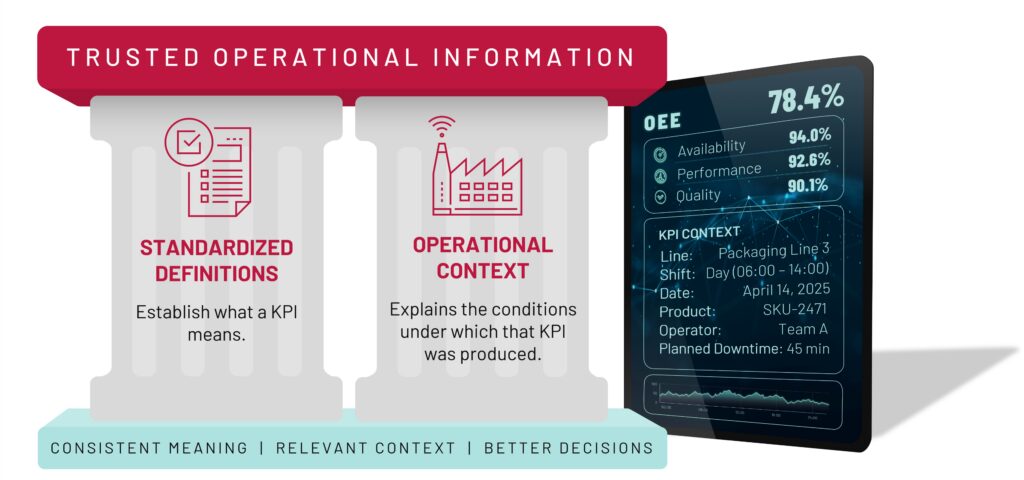
Trusted operational information rests on two pillars: standardized definitions that establish what a KPI means and operational context that explains the conditions under which it was produced. Remove either pillar, and information becomes more difficult to compare, trust, and scale (Figure 1).
Figure 1: Trusted operational information rests on two pillars: standardized definitions and operational context
Poor Data Outcomes Despite Good Operations
Control systems are designed primarily to execute and protect processes, not to preserve and deliver the context needed to “run the numbers” across an enterprise. If production targets are met, most organizations consider those systems healthy.
Operators understand when a line is starting up, changing over, blocked, starved, or running under unusual conditions. Much of that operational context has historically lived in people, procedures, and local conventions.
Many manufacturing execution (MES) and manufacturing operations management (MOM) systems provide contextualization, but inconsistent definitions across sites and functions can still prevent information from being compared or reused consistently.
The Collaborative Ecosystems Smart Manufacturing Innovation Institute’s (CESMII) Smart Manufacturing Profiles illustrate a broader industry shift toward formalizing asset definitions, operational context, and business logic into reusable information models that can scale across systems and facilities.
The Real Cost Is Data Friction
Manufacturers seldom consider OT technical debt a technology failure. More often, they experience it as data friction—the added effort required before information can be used confidently. This friction appears as recurring KPI disputes, duplicate calculations, spreadsheet validation, custom integrations, and investigations into why trusted reports disagree.
Consider two packaging lines reporting downtime. One plant classifies blocked conditions as downtime, while another records it as an external constraint. Both approaches may be reasonable locally. Once the results reach a corporate dashboard, however, comparison becomes difficult because the definitions are different.
“Rather than striving for perfect data, organizations should aim to preserve meaning as information moves across systems, facilities, and business functions.”
The resulting cost is not only labor spent reconciling reports but also delayed capital decisions, slower deployment of successful practices, and reduced confidence in operational benchmarks.
Interoperability tools can address these challenges by providing a common way to access contextualized manufacturing information across platforms. More importantly, such tools reflect an industry recognition that reducing translation effort is essential to scaling Smart Manufacturing initiatives.
More Data Can Worsen the Problem
When data challenges emerge, organizations often respond by collecting more information.
A motor current spike during production may signal a developing mechanical issue, while the same spike during startup may be completely normal. Throughput calculations can vary depending on where measurements are taken. Downtime measures can change based on how a site defines running, idle, changeover, or blocked conditions.
These discrepancies are not technology failures: they result from missing production context, inconsistent KPI definitions, and fragmented ownership of operational information.
The same challenges affect AI initiatives. AI systems inherit the assumptions embedded within the information they consume. When definitions and operational context vary across facilities, recommendations may be technically correct according to local definitions but inconsistent at the enterprise level.
Manufacturers that achieve greater value from analytics and AI focus first on reducing ambiguity in the information they already possess.
Building a Foundation for Scalable Insight
Some organizations respond by modifying control systems to accommodate reporting and analytics—an approach that often introduces additional risk and maintenance complexity.
A more scalable approach is to separate process execution responsibilities from information interpretation and governance responsibilities. While control systems remain responsible for execution, data platforms provide the foundation for contextualization, standardization, and governance.
Several capabilities are foundational:
- Explicit operating states with consistent definitions.
- Operational context connected to assets, products, batches, and events.
- Governed KPI definitions with clear ownership and calculation methods.
- Reusable business logic shared across reporting and analytics applications.
Shared ownership is equally important. Operations define performance, controls teams protect execution integrity, IT manages architecture and security, and data teams maintain reusable definitions. Value is realized through collaboration rather than isolated ownership.
The objective is not perfect data—it is preserving meaning and consistency as information moves across systems and facilities.
A Roadmap for Reducing Data Friction
Reducing data friction is less about technology and more about establishing a repeatable process for creating trusted operational information (Figure 2).
Figure 2: A high-level roadmap for leadership to reduce data friction

It progresses from identifying where decisions stall to scaling a proven information model through three steps:
- Start and Prioritize: Identify where KPI disputes, manual reconciliation, or delayed decisions are limiting performance, then focus on the metrics and processes you intend to scale.
- Define and Build: Establish common KPI definitions and operating states, then create reusable information models that preserve operational context without modifying control systems.
- Govern and Prove: Assign ownership for definitions and business logic, measure outcomes, and expand successful approaches across additional sites and use cases.
Rather than striving for perfect data, organizations should aim to preserve meaning as information moves across systems, facilities, and business functions.
Why Trust Becomes a Competitive Advantage
MLC research identifies data quality, integration, and governance as persistent barriers to scaling digital transformation, while Rockwell Automation’s latest State of Smart Manufacturing Report highlights operational intelligence as an emerging differentiator. Both point to the same reality: technology often scales faster than the information foundation needed to support it.
Manufacturers have spent the last decade learning how to collect more data. The next decade may be defined by how effectively they preserve its meaning. As analytics and AI scale, the challenge is no longer access to information but confidence in it.
Information can only scale when its meaning remains intact. M
Author bio:

Troy Mahr is a Director of Industrial Data Management at Kalypso, a Rockwell Automation Business.