Empowering Frontline Workers with 3D Models and IoT Data
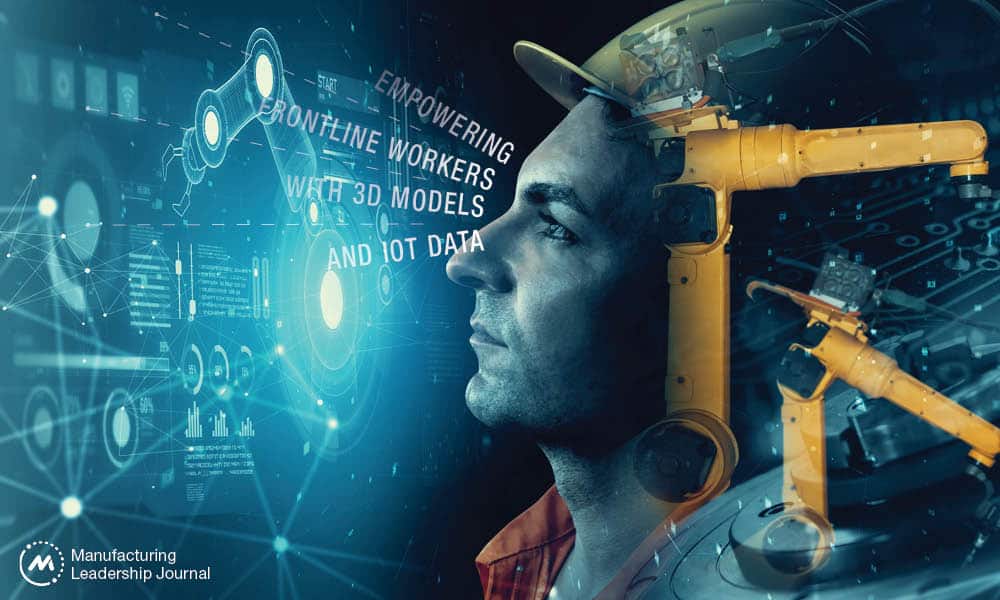
Advanced technology and data are helping manufacturers’ frontline workers become more productive.

TAKEAWAYS:
● The connected worker solution integrates MBD/E with IoT and AR to provide workers with real-time information, guidance, and feedback.
● Improved agility, compliance, and quality, increased efficiency, and empowered employees are just some benefits of the connected worker solution.
● Adopting a connected worker solution in manufacturing requires a strategic and flexible approach.
“Connected Frontline Workforce (CFW) applications are a strategic differentiator to successfully address daunting challenges in safety, sustainability, productivity, quality, and overall margin goals,” said Allison Kuhn, EHS/Sustainability, Future of Industrial Work Research Analyst, of LNS Research. “CFW applications are proven human-centric platforms that accelerate business value with real-time insights and knowledge management, leading to faster, better decisions.”
Discrete manufacturers face significant challenges, including global competition, rising customer expectations, increasing product complexity, and workforce shortage—all while needing to simultaneously capture significant improvements in productivity. These challenges necessitate a transformation towards agile, efficient, and resilient operations. Despite the automation of many dull, dirty, and dangerous tasks, frontline workers remain the vital component in this transformation. However, they are expected to perform today’s tasks at tomorrow’s speed with yesterday’s resources. A Forrester study1 found that 77 percent of frontline workers don’t have access to the technology they need to be productive. Strategic technological support is therefore crucial for actionable insights, enhanced human-machine interactions, effective collaborations across value chain, as well as for fostering improved decision-making and operational efficiency.
A model-based connected worker solution (hereafter called the “connected worker”) is a key technological enabler; it integrates model-based definitions and enterprise (MBD/E) with Internet-of-Things (IoT), augmented reality (AR), analytics, and artificial intelligence (AI). MBD/E, as a key facet of industrial digital transformation, uses 3D models as the authoritative source throughout the product lifecycle. The 3D model contains vital details like geometry, tolerance, manufacturing notes, as well as associated derivatives like manufacturing bill of materials, routing, work instructions, computer numerical control (CNC)/coordinate measuring machine (CMM) programs, control plan/characteristics, etc. With 62 percent of large manufacturers adopting or considering MBD/E strategies, and 57 percent of executives prioritizing them, according to Tech-Clarity2, the connected worker solution is timely and a booster to connected frontline worker initiative.
The strength of the connected worker lies in how 3D models amplify the impact of IoT, AR, analytics, and AI technologies, which have already been adopted or are being adopted by industry leaders to empower frontline workers. With the increasing adoption of MBD/E, these 3D models serve as a powerful booster by further enhancing the capabilities of frontline workers. The unique value that 3D models bring to connected workers includes
Howard Heppelmann is divisional vice president and general manager of PTC’s ThingWorx IoT Solutions.

Dirk Schart is senior director Go-to-Market at PTC and leads the global Vuforia marketing.

James Zhang is vice president of Market Development, IoT at PTC.

- Need more information: Contact the team at PTC