Building an OT Organization in an IT World

As OT capabilities grow, leaders need intentional structures to unify IT/OT roles, refine workflows, and enable digital transformation to scale.
TAKEAWAYS:
● Successful IT/OT integration requires a clear understanding of current personas, workflows, and capability gaps across both technical and operational domains.
● Technology investments should intentionally free up time for higher-value work and reshape responsibilities across IT and OT roles.
● A future-ready IT/OT structure must be adaptable to company size, talent availability, and evolving digital and operational technology needs.
The operating technology (OT) landscape is rapidly evolving. Many industrial operations now rely on OT solutions that didn’t even exist five years ago. With this accelerated change, manufacturers struggle to evolve their organizational structures to keep pace and properly govern the OT space.
Some organizations have applied the same governance models to both IT and OT, but with limited success. In reality, OT presents distinct challenges compared to IT, including strict uptime requirements, harsh environments, equipment-level connectivity, and varied user sophistication.
This structural lag often causes confusion over who truly owns OT—whether IT, engineering, or operations—and can prompt a “land grab” for responsibility. This struggle can produce a site- or project-specific approach to OT, leaving it disconnected from a broader technology strategy. Without a deliberate, integrated approach, OT efforts become isolated, making it harder to replicate successes, share lessons learned, or drive transformation across the enterprise.
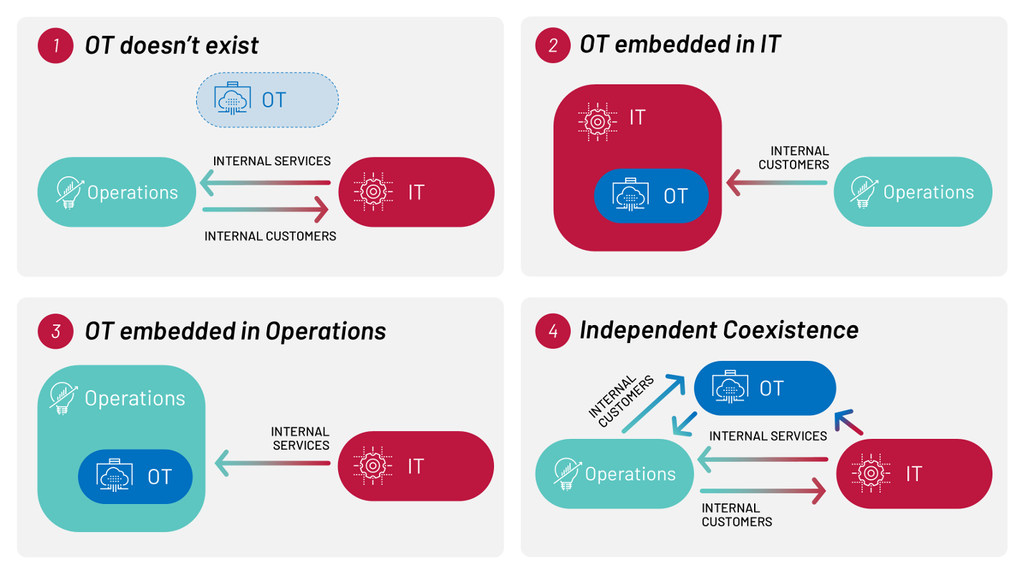
Current State of IT/OT Organization Structures
Designing Your Future IT/OT Organization
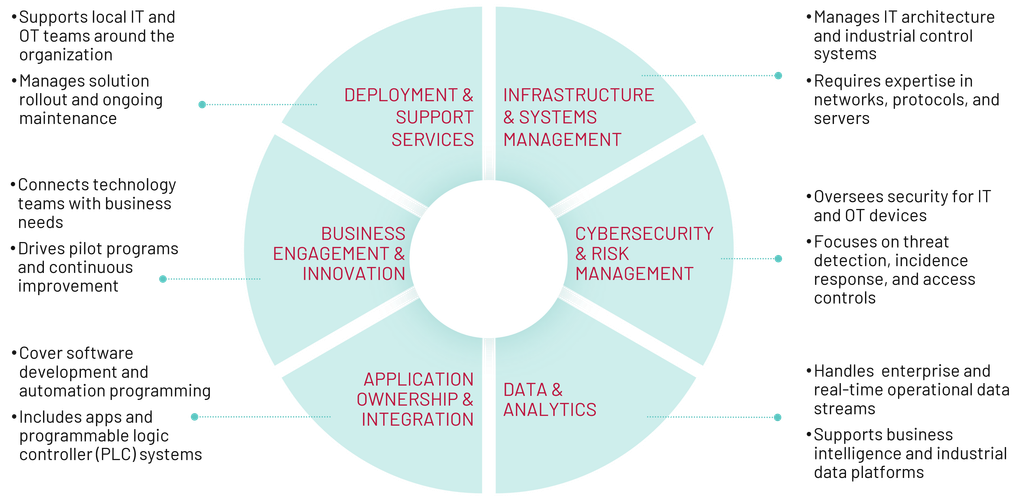
Note: Many IT and OT team responsibilities fall into these six domains.
Start by inventorying your organization’s current capabilities across these six domains. Identify the critical responsibilities your new organization must manage. Then, evaluate each capability’s current maturity level and its strategic importance to future business and technology objectives. These maturity levels and responsibilities will inform time allocation, gap analysis, and the key workflows that your organization must be able to perform.
Step 1: Understand Current Personas and Responsibilities

Step 2: Assess Time Allocation Opportunities
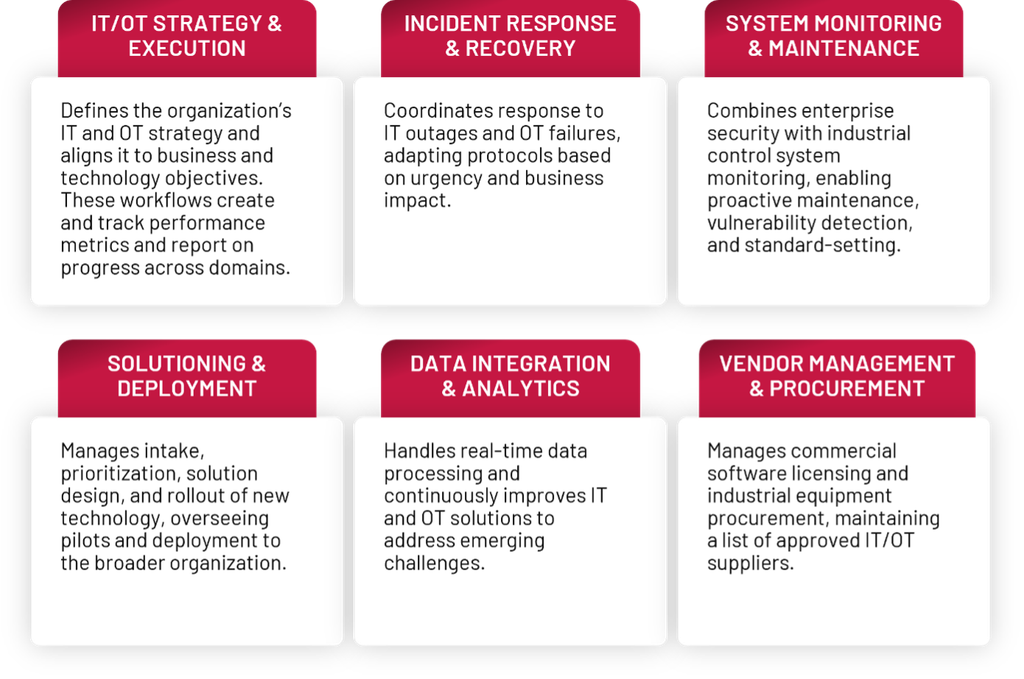
These critical processes will form the foundation of the newly designed IT/OT organization, establishing standards for communication and collaboration regarding how members will perform critical functions.
Technology can automate workflows, reducing the manual effort and time required. As AI agents, dashboards, and workflows increasingly automate system monitoring, incident response, and vendor management, a future-focused IT/OT organization must carefully assess how new technology initiative will change staffing roles and responsibilities.
Step 4: Skills Matrix and Gap Analysis
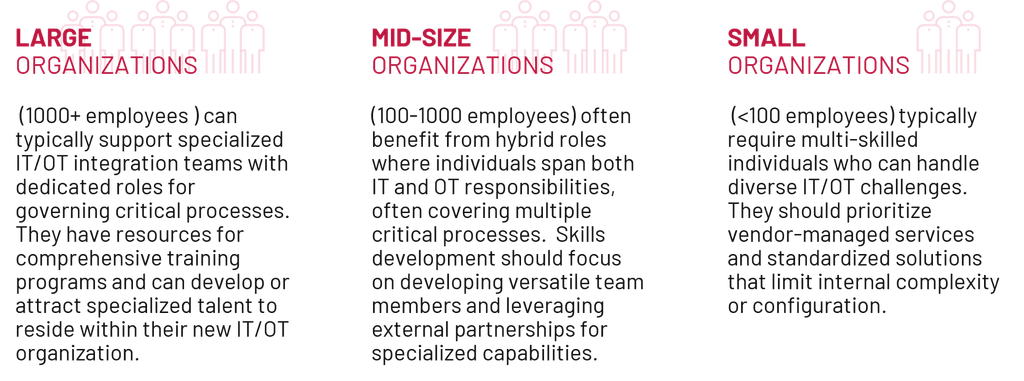
Organizations in major metropolitan areas typically have access to diverse talent pools, enabling them to recruit specialists in both IT and OT. In contrast, rural, specialized, or localized industrial locations may need to focus on developing existing talent, agentic capabilities to elevate existing skillsets, or leveraging remote work arrangements to access specialized IT and OT skills.
It’s important to assess your competitive position in the talent market and adjust your organizational design accordingly. Some organizations may benefit from hybrid arrangements with shared service centers, while others may need to simplify governance, limit locally managed processes, or tailor responsibilities to match available skillsets.
Step 6: Mapping Processes to Roles
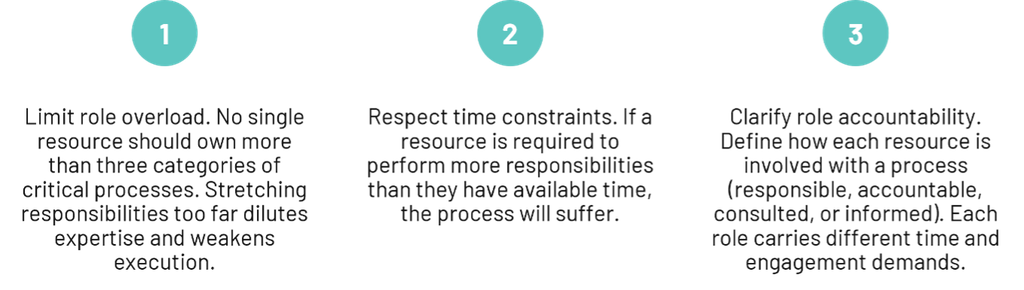
Successfully designing a joint IT/OT organization begins with assessing current capabilities and resources, understanding critical workflows, and thoughtfully considering company-specific realities. Whether your organization employs standalone IT and OT functions, an IT-, operations- or engineering-led model, or nested OT functions within IT, success depends on an the organization’s ability to serve its internal functions effectively.
As technologies evolve and business needs shift, IT/OT structures must adapt to sustain operational efficiency. Organizations that build adaptability and innovation into their foundational design will achieve sustainable operational efficiency in an increasingly connected industrial landscape.
By following this framework, companies can move beyond disjointed, ad-hoc IT/OT collaboration toward a purpose-built structure. This structure aligns strategy with execution, capabilities with business imperatives, and people with processes that drive value, resulting in a future-ready organization positioned to thrive in the converged digital and operational technology landscape. M
About the authors:

Will Rosengarten is Data Strategy & Architecture Lead at Rockwell Automation Digital.

Thomas Swigon is a Senior Consultant at Rockwell Automation Digital.