
Smart AI Moves: Build Your Supply Chain Step by Step
To turn supply chain challenges into opportunities and accelerate transformation, build the right AI foundation to walk before you run
TAKEAWAYS:
● Building a solid AI foundation is crucial for successful supply chain transformation.
● Identifying strategic goals ensures AI applications deliver tangible value to your business.
● Proper support across people, processes, and technology is key to maximizing AI’s potential in supply chains.
Technology is another limiting factor across operations. One common issue is fragmented and legacy technology applications where best of breed solutions are deployed on a per function basis. Additionally, many organizations have under-adopted the technology in which they have invested. For instance, they have a transportation management system but still use manual outreach to connect with carriers. They have a planning system, but planners still pull information into Excel or custom tools for analysis and then load the output back into the system afterward. In the MLC’s Future of Manufacturing Project Survey, 68% of manufacturers said they still use spreadsheets for data analysis.
3) Conduct a cost-benefit analysis for AI use cases that could solve your business problem
Once you have defined specific supply chain strategies and identified challenges to delivering on those strategies, you can begin evaluating AI use cases that solve the business problem—determining which use cases provide the best potential return on investment.
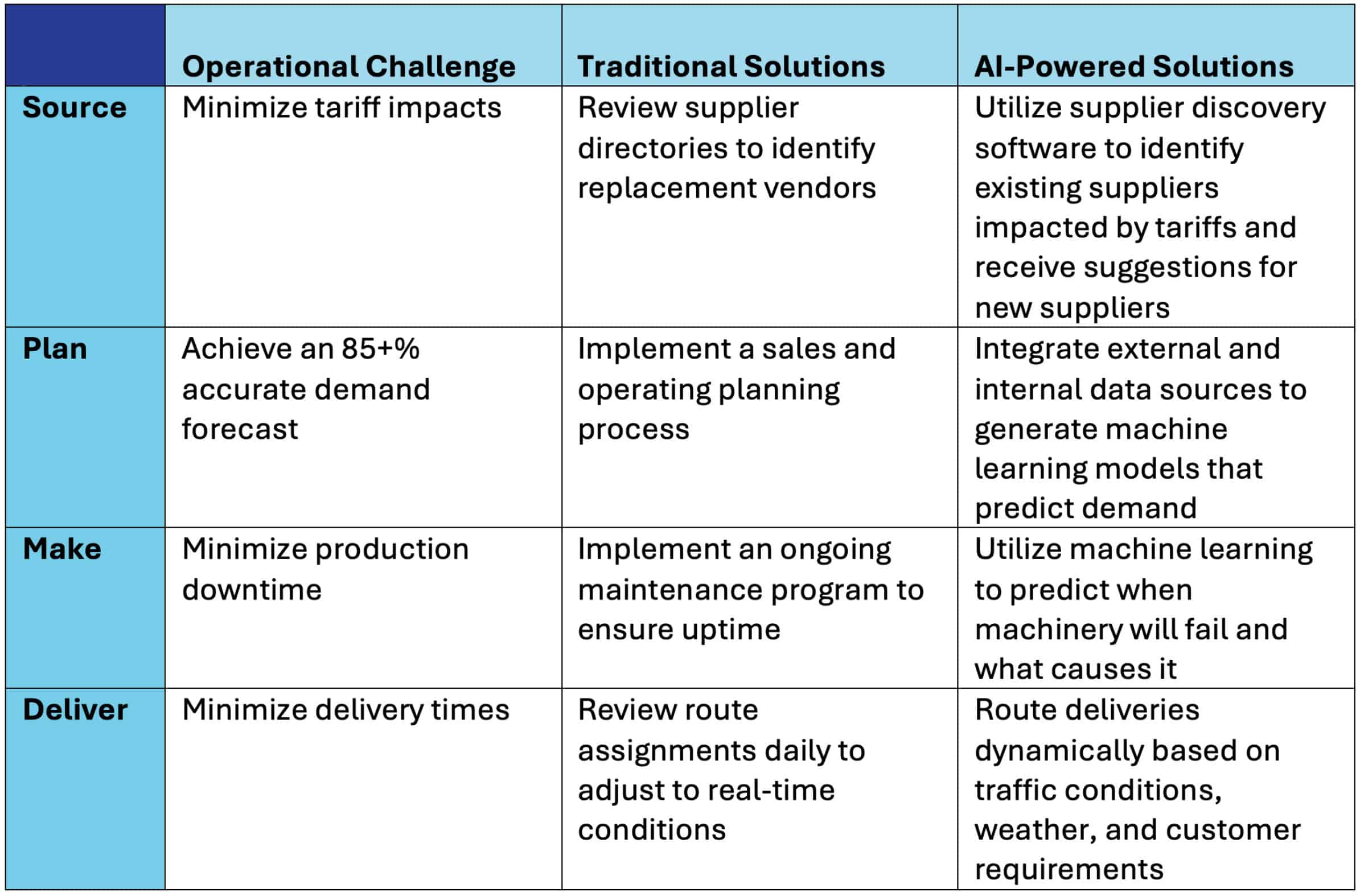
When identifying possible AI use cases, don’t assume AI is the correct answer for addressing a challenge. Instead, look at solutions across people, processes, and technology to determine which solution or combination of solutions—including AI—is best suited to resolving the problem. This ensures you are applying AI in a way that can solve a problem better than other alternatives.
The following are several simplified examples of common operational challenges across the SCOR supply chain model, and the traditional and AI-powered solutions that may address them.
4) Support the selected use cases adequately
You will need the right support capabilities to build AI use cases for maximum value. To do so, look at each use case through three lenses. These are some key considerations for each area:
People
- End-user skills that align with and can support the identified AI use case
- Defined individual and functional responsibilities for supporting a use case
- Ongoing training and informational resources
- Change management and upskilling as needed
- Sufficient internal IT support capabilities
- Job requisitions that integrate AI to support the acquisition of the right talent
Processes
- Supply chain processes redesigned to integrate and embed AI and maximize its utility, rather than just tacking it on to existing processes—for example, redesigning an existing S&OP process to incorporate AI-driven demand planning
- Increased automation, where possible, to produce data for AI analysis and maximize the benefits of AI output
Data and technology
- Assessment of data in its current form to determine whether it can support the identified use case and what, if any, remediation is required to improve data quality and access
- A master data governance program/policy that ensures data maintains conformance with AI use case requirements
- Networks and/or SaaS instances that can support the demand of deployed AI use cases
Finally, it is essential to consider whether current systems can provide sufficient AI/ML capabilities or whether you will need a new solution. Many Tier 1 supply chain solution providers, such as SAP and Oracle, continuously embed new AI and other advanced analytical features into their products. These AI-driven insights can help optimize supply chain management and manufacturing processes—for example, streamlining product development, detecting equipment anomalies, improving field response, predicting ship lead times, sensing demand, facilitating dynamic discounting, and more.
When you can walk, you’re that much closer to running
Approaching these activities strategically and sequentially not only takes you from baby steps to a full stride. It prepares you to accelerate your pace to “run”—with AI integrated into your supply chain processes, skill requirements embedded in training and hiring to build an AI-fluent organization, and AI-native technologies supporting your operations. That’s when you will really begin to see the value from the data and technology in your supply chain ecosystem. M
About the authors:
Brian Pacula is a Partner at West Monroe.

Sri Sripada is a Managing Director at West Monroe.

Ian Nugent is a Principal at West Monroe.

To turn supply chain challenges into opportunities and accelerate transformation, build the right AI foundation to walk before you run
TAKEAWAYS:
● Building a solid AI foundation is crucial for successful supply chain transformation.
● Identifying strategic goals ensures AI applications deliver tangible value to your business.
● Proper support across people, processes, and technology is key to maximizing AI’s potential in supply chains.
Technology is another limiting factor across operations. One common issue is fragmented and legacy technology applications where best of breed solutions are deployed on a per function basis. Additionally, many organizations have under-adopted the technology in which they have invested. For instance, they have a transportation management system but still use manual outreach to connect with carriers. They have a planning system, but planners still pull information into Excel or custom tools for analysis and then load the output back into the system afterward. In the MLC’s Future of Manufacturing Project Survey, 68% of manufacturers said they still use spreadsheets for data analysis.
3) Conduct a cost-benefit analysis for AI use cases that could solve your business problem
Once you have defined specific supply chain strategies and identified challenges to delivering on those strategies, you can begin evaluating AI use cases that solve the business problem—determining which use cases provide the best potential return on investment.
When identifying possible AI use cases, don’t assume AI is the correct answer for addressing a challenge. Instead, look at solutions across people, processes, and technology to determine which solution or combination of solutions—including AI—is best suited to resolving the problem. This ensures you are applying AI in a way that can solve a problem better than other alternatives.
The following are several simplified examples of common operational challenges across the SCOR supply chain model, and the traditional and AI-powered solutions that may address them.
4) Support the selected use cases adequately
You will need the right support capabilities to build AI use cases for maximum value. To do so, look at each use case through three lenses. These are some key considerations for each area:
People
- End-user skills that align with and can support the identified AI use case
- Defined individual and functional responsibilities for supporting a use case
- Ongoing training and informational resources
- Change management and upskilling as needed
- Sufficient internal IT support capabilities
- Job requisitions that integrate AI to support the acquisition of the right talent
Processes
- Supply chain processes redesigned to integrate and embed AI and maximize its utility, rather than just tacking it on to existing processes—for example, redesigning an existing S&OP process to incorporate AI-driven demand planning
- Increased automation, where possible, to produce data for AI analysis and maximize the benefits of AI output
Data and technology
- Assessment of data in its current form to determine whether it can support the identified use case and what, if any, remediation is required to improve data quality and access
- A master data governance program/policy that ensures data maintains conformance with AI use case requirements
- Networks and/or SaaS instances that can support the demand of deployed AI use cases
Finally, it is essential to consider whether current systems can provide sufficient AI/ML capabilities or whether you will need a new solution. Many Tier 1 supply chain solution providers, such as SAP and Oracle, continuously embed new AI and other advanced analytical features into their products. These AI-driven insights can help optimize supply chain management and manufacturing processes—for example, streamlining product development, detecting equipment anomalies, improving field response, predicting ship lead times, sensing demand, facilitating dynamic discounting, and more.
When you can walk, you’re that much closer to running
Approaching these activities strategically and sequentially not only takes you from baby steps to a full stride. It prepares you to accelerate your pace to “run”—with AI integrated into your supply chain processes, skill requirements embedded in training and hiring to build an AI-fluent organization, and AI-native technologies supporting your operations. That’s when you will really begin to see the value from the data and technology in your supply chain ecosystem. M
About the authors:
Brian Pacula is a Partner at West Monroe.
Sri Sripada is a Managing Director at West Monroe.
Ian Nugent is a Principal at West Monroe.
Related News
MLC Plant Tour: End-to-End Digital at Analog Devices and Lilly
October 5, 2026If you’re asked to picture the things that are “quintessentially Irish,” you might think of verdant landscapes, thatched-roof cottages, craft whisky and pub culture. But there is an additional, important element to add to that list: Ireland is also a global leader in advanced manufacturing. The Manufacturing Leadership Council recently brought around 100 of its…

Executive Dialogue: Leading at AI Speed
September 30, 2026Alan Machuga of Rheem explains why the future of AI isn’t content creation—it’s better business decisions. Penelope Brown: Hello, everyone, and welcome to today’s edition of Executive Dialogue from the Manufacturing Leadership Council. Today I am super excited to be talking to Alan Machuga, who is the Executive Vice President of Digital Strategy and AI…

Building An AI Governance Framework for the Factory Floor
May 21, 2026AI governance doesn’t have to be overwhelming. Learn the five key pillars manufacturers need to confidently scale AI.
