Turbulence Ahead?
The latest Manufacturing Leadership Council survey on Factories of the Future shows that manufacturers are anticipating significant progress in adopting Manufacturing 4.0 technologies in the next two years, but an economic down-turn this year could slow them down. By Penelope Brown
After taking a beating in the recession of 2008-09, U.S. manufacturing made a gradual but uneven recovery. The industry lost 20% of its output and 15% of its jobs at the bottom of the recession, then climbed its way through a credit crunch, a weak export market due to a strong dollar, a handful of supply chain-crippling natural disasters, and the far-reaching business effects of low oil and gas prices. Finally, after years of slow ascent, manufacturers are again steadily reaping the benefits of high demand and high profitability.
Concurrent with the industry’s return to economic growth has been the rise of the digital shop floor, as new technologies have taken hold for improving capacity, efficiency, and productivity. Those same technologies promise improved flexibility for product design and customization, better insight on plant floor equipment status, responsive and timely error detection, and extended knowledge about a product’s lifecycle.
But while the latest technologies offer great promise to deliver on those benefits, they also require significant financial and time investment. It takes money to buy new equipment; it takes time to develop a new digital strategy or to train employees on new skills. In a strong business climate, manufacturers have shown willingness to expend those resources. But as a growing number of signs raise the question of whether a downturn will occur this year, will that uncertainty cause manufacturers to defer or reduce overall tech spending and slow their transition to M4.0?
PART 1: STATUS OF M4.0 ADOPTION
1 One-Third are Experimenting with M4.0 Pilot Projects
Q: What is the overall progress level for M4.0 adoption at your company?
2 Speed, Flexibility and Cost Savings Seen as Biggest Benefits
Q: What are the most important benefits and opportunities your company hopes to realize from embracing M4.0?
Only 7% of manufacturers said their factory leadership is fully ready to undertake the transition to M4.0.
3 M4.0 Expands Beyond the Factory Floor
Q: Which of the following non-manufacturing functions have begun the adoption of M4.0?
Respondents to the Manufacturing Leadership Council’s Factories of the Future survey shared insight on current digital technology deployment in manufacturing, and the trends that are likely to emerge soon. When it comes to the biggest benefits that manufacturers hope to realize from Manufacturing 4.0, the top three responses were better operational efficiency (57%), greater speed and flexibility (55%), and cost reduction (47%). (Chart 2) But forty-five percent of manufacturers responding to the survey said that a lack of access to adequate investment is a roadblock to implementing M4.0 strategy (Chart 14). While budgets aren’t the only challenge to making the transition, it seems probable that a shifting economic wind could also mean a slower shift to M4.0.
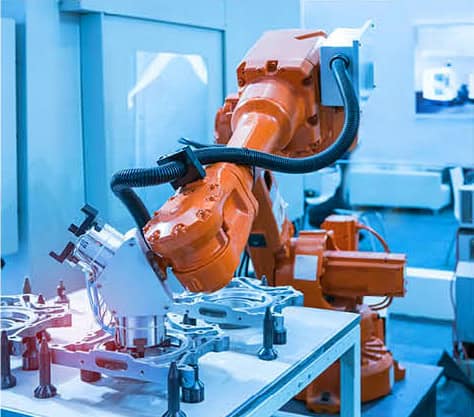
AI, Machine Learning, Cobots on the Rise This isn’t to say that manufacturers don’t have big plans. A third of those surveyed are experimenting with small-scale M4.0 pilot projects, while 12% say they have implemented it companywide (Chart 1). Many have sights on leveraging the promise of machine learning and artificial intelligence, from 8% of respondents who say they are using it now to 50% who say they will be using it in two years’ time (Chart 4). But there were two divergent areas where respondents most commonly saw its immediate application: 35% said production optimization, while 25% said equipment maintenance/service.
Maintenance and service is one area that is ripe to see an uptick in digitization, thanks to the increasing application of analytics and predictive maintenance. While only 7% of survey respondents said their maintenance and service is digitized currently, 35% said that it will be digitized in two years (Chart 10). Additionally, 31% said they will be using analytics to assess the status of plant floor equipment in two years, compared with 4% who say they are doing such monitoring now (Chart 8). Manufacturers expect to deploy more collaborative robotics in the next two years, with 21% saying they will use cobots extensively in two years and 31% saying they will use them partially (Chart 6). This is likely due to their affordable unit cost and relative ease of deployment by being small, flexible, and capable of taking on repetitive tasks to free human workers for more complex work. The most common M4.0 technologies in use are robotic process automation and modeling and simulation tools – 80% of manufacturers are either using them now or plan to be in two years. Plants will continue to become interconnected, with 86% of respondents saying their plant floors will be either extensively or partially networked and IP enabled in two years, compared with 65% who say they are extensively or partially networked now (Chart 7).
PART 2: MEASURING DIGITIZATION
4 Big Plans for Cobots, AI, Advanced Data Analytics
Q: Where does your company stand in regard to the following technologies?
5 Machine Learning Can Optimize Production, Service
Q: What do you see as the most immediate application for machine learning/AI on your factory floor?
Only 7% of manufacturers said their factory leadership is fully ready to undertake the transition to M4.0.
6 Cobots Will Be a Growing Presence
Q: How extensively are you using collaborative robotics now, and what do you anticipate your company’s level of use will be in 2 years?
7 Plant Floor Networks Grow More Substantial
Q: How would you describe the extent to which your plant floor is networked and IP enabled today, and what do you anticipate the extent will be in 2 years’ time?
8 Analytics Keep Watch on Equipment, Errors
Q: To what extent is your company using analytics to assess plant floor equipment status and to avoid production errors, and what do you anticipate will be the extent in 2 years’ time?
9 Digitization of Production/Assembly on the Rise
Q: To what extent is your production/assembly process digitized today, and what do you anticipate the extent will be in 2 years’ time?
10 Maintenance, Service Will See Increased Digitization
Q: To what extent is your plant floor equipment maintenance and service digitized today, and what extent do you anticipate it will be in 2 years’ time?
Culture and Leadership: The Big Wake-Up Call
One stark data point from the survey: Nearly 30% of respondents said their plant leadership is not M4.0 ready, and they are doing nothing to prepare. More than one-third of respondents – 36% — said they were just at the beginning of skill development for leadership. Others were identifying their deficiencies and making a plan to address them (14%) or improving their skills and nearing readiness (14%). Only 7% said that their plant leadership was fully M4.0 ready (Chart 16). Culture was cited as a major challenge to M4.0 implementation, with 68% saying leadership needed to address changes to company culture. But there are signs that old norms are giving way. Thirty-two percent said they anticipate that their company’s plant management will be “collaborative” in two years, with more involvement from employees, customers, and suppliers, up from 21% who say their company’s plants are managed that way currently. Only 8% of respondents anticipate a command-and-control plant management structure in two years, down from 13% managed that way currently (Chart 13). These small shifts are the gradual but noticeable changes in an M4.0 world, where culture moves away from its traditional characteristics like hierarchy, top-down decision making, and a resistance to change. As manufacturing continues its digital journey and hires for a growing number of data- and digital-focused roles, this cultural shift will be necessary to compete with other industries for top tech talent. In other words, the competition for workers won’t just come from the factory up the street, but also from tech giants like Google and Amazon. Companies must embark on creating a forward-thinking culture or they risk missing out on the best and brightest digital talent.
PART 3: FACTORY ORGANIZATION AND MANAGEMENT
11 Benchmarking Grows for Performance Assessment
Q: Do you have a set of metrics for benchmarking performance at your factories?
12 IT, OT Teams Are Collaborative But Separate
Q: To what extent are your IT teams and OT teams working together?
Forty-five percent of surveyed manufacturers said that a lack of access to adequate capital is a roadblock to implementing M4.0.
13 Factories Move Away from Centralized Management
Q: How would you characterize how your factories/plants are managed today and what do you anticipate will be the primary way they will be managed in the next 2 years?
Dedicated to an M4.0 Transition
Though implementation challenges most certainly will persist, it’s clear that manufacturers see the importance of M4.0 and remain dedicated to its deployment. Fifty-five percent of manufacturers surveyed said that M4.0 is a “game-changer, truly a new era” for the industry. While 64% believe that implementing M4.0 will confer a unique competitive advantage, 36% say that it is now table stakes required to stay in the game (Charts 17, 18). The good times for business have brought about new markets, new products, new businesses, and new ways of thinking about what’s possible. Even if the economic skies show gathering clouds in the months ahead, companies that leverage these opportunities will find themselves in a better competitive position, able to maintain stability even in times of uncertainty. M