
News and Insights

AI with Open and Scaled Data Sharing in Semiconductor Manufacturing
September 30, 2025Open, scaled data sharing can turn raw manufacturing data into AI-ready assets, improving productivity, resilience, and workforce effectiveness. A semiconductor workshop benchmarked near-term economic value from collaborative data ecosystems and virtual metrology applications.

The Foundations of Enabling an M4.0 Supply Network
April 1, 2025Manufacturing 4.0 supply networks require digital visibility, collaboration and agile execution. Treating suppliers as an extension of the business helps improve quality, speed and resilience.

What’s Ahead for Manufacturing in 2024?
February 7, 2024Experts say manufacturers should prepare for a mixed 2024 outlook, with tight labor, regulatory pressure and recession risks offset by strong construction, AI adoption and resilience-focused digital strategies.

The Need to Accelerate Industrial AI Adoption By 2030
December 8, 2022Manufacturers must urgently accelerate AI adoption as it becomes a major driver of competitiveness, productivity, and operations by 2030, with ethics and workforce impacts also emerging.

Manufacturing in 2030 Megatrend: Ride the Power Curve
November 22, 2022Manufacturing’s 2030 digital future will depend on advances in electronics, computing, communications, software and cyber infrastructure, enabling more powerful automation, AI and connected operations.

Dialogue: Intel’s Sustainable Vision
November 18, 2022Intel CSO Todd Brady says sustainability strengthens business, highlighting Intel’s goals for net zero emissions, renewable energy, water positivity and industry-wide collaboration to drive climate action.

The Shift to 4.0 Supply Chains
March 29, 2022Manufacturers are rethinking just-in-time supply chains after recent disruptions, shifting toward regional networks, buffers, and digital tools to improve visibility, agility, and resiliency.

Blockchain in the Semiconductor Industry: 5 Innovative Use Cases
December 17, 2021Blockchain technology is set to empower the semiconductor industry to expand its business horizons.
Blockchain can help semiconductor manufacturers improve supply chain visibility, collaboration, and traceability while reducing counterfeits and costs. Its secure, transparent records and smart contracts also support compliance, IP protection, and automation.
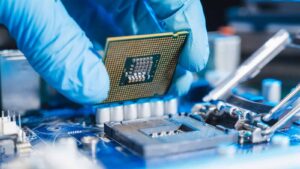
How Cloud Computing Could Help Chip Manufacturers
October 18, 2021Cloud computing could help chip manufacturers speed design, improve data-driven decisions, and maintain service continuity, potentially easing semiconductor shortages.
10 Reasons Why Semiconductor Firms Should Rapidly Embrace Cloud
September 23, 2021Cloud computing helps semiconductor firms speed chip design, improve foundry yield, strengthen collaboration and security, and optimize costs. It supports faster time to market and more efficient R&D and operations.
