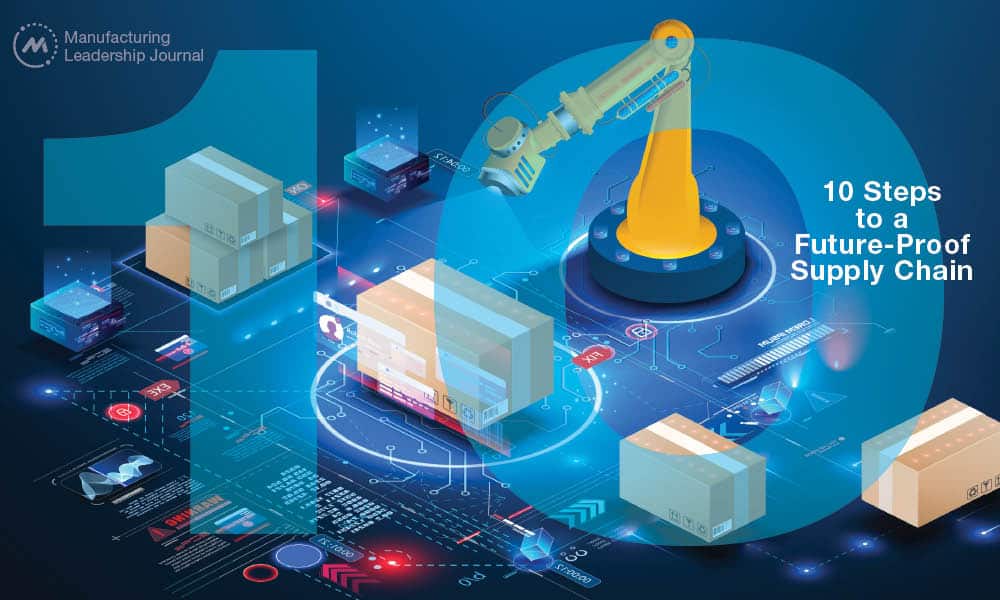
10 Steps to a Future-Proof Supply Chain
This pragmatic approach to building resilient M4.0 supply chains is essential for thriving in today’s new normal.
This pragmatic approach to building resilient M4.0 supply chains is essential for thriving in today’s new normal.

Future proofing manufacturing supply chains, building resilience and the capability to proactively respond to disruption is no longer a case of if but when. Without exception, over the past two years, every manufacturing business has had its supply chains disrupted and most continue to face uncertainty, challenged by the impact of the COVID-19 pandemic, geopolitical instability, macro weather events, trade wars, and climate change. Developing a robust, resilient supply chain is a whole-of-business problem, a strategic imperative that must be treated with urgency.
The sales, production, and supply chain teams often participating in the gamesmanship of balancing supply with demand need to unite more than ever before and tackle both the tactical and strategic aspects of mitigating disruption and building resilience. This work must be done now, building on the initiatives that most companies commenced over the past two years. Here is a pragmatic, 10 -step process manufacturing businesses can follow on their journey to achieving now-essential resilient M4.0 supply chains.
Welcome to the New Normal
In the first quarter of 2020, as the world experienced the initial impacts of the COVID-19 pandemic, many considered the supply chain disruptions temporary as critical supply chains such as food bounced back, and the shopping aisles started to restock. However, as the year progressed it became apparent that we would not be returning to normal. In his book, The New (AB)Normal, published in October 2020, MIT Professor Yossi Sheffi described how we are entering an era of uncertainty which will reshape business and supply chain strategy. The Economist Intelligence Unit in an August 2020 briefing document commented that we have entered an era of turbulence and that companies that recover from the pandemic should seek to build resilience and adapt to a new normal.
Fast forward to today and these predictions have been proven true, the pandemic continues to disrupt as new waves ripple around the globe, the long-term effects still significantly disrupting supply chains as the semiconductor shortages disrupt manufacturing, tens of thousands of containers remain stranded on ships waiting to be offloaded, and geopolitical tensions rise. Some manufacturing businesses that were unable to adapt to the normal did not survive, while others are just barely surviving. However, others that have been more agile and adaptable than their competition are thriving.
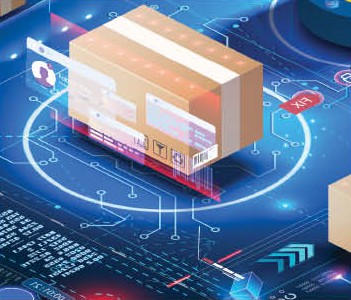
Step 5: Risk Identification and Alerting In this step, the team focuses on the high-risk supply chains with the objective of identifying the causes of risk. As a starting point, the collaborative supply chain maps can be used to annotate areas of concern, with particular focus on identifying risk indicators and possible measures and alerts for these indicators. Are there systems or sensor data that can be integrated into a dashboard for alerting should one of these risk indicators reach a trigger point? Could tracker and condition monitoring sensors be used to track critical components or products? Examples include weather monitoring and ingestion of weather forecast data along routes that are sensitive to extreme weather events. Alerting and even predicting weather-related supply chain disruptions would enable the team to take proactive risk mitigation steps such as alternative routing or early delivery of the products. Deployment of GPS trackers, including more advanced temperature monitoring capability, could alert when time- and temperature-sensitive consignments are at risk. The first stages of developing a digitized supply chain risk dashboard can present such alerts in near real time.
Step 6: Tactical Risk Mitigation Identifying or predicting risk enables the team to take proactive risk mitigation measures. The power of the cross-functional team come as it engages in a series of scenario planning and what-if analysis. Much can be achieved with the trusty collaborative supply chain map; however, a skilled supply chain or business analyst may also provide a simulation of the supply chains using one of the several commercially available solutions, which will add a further layer of robustness to the planning sessions. The key question being tackled is “what can be done to mitigate the risks identified or predicted in Step 5?” As the team discusses each risk scenario and debates, assesses and selects potential mitigations, it develops a risk mitigation playbook. The intent is that the playbook provides the detailed steps for initiating Plan B, be it an alternative routing, alternative supply, or even substitution of a component and the various supporting business processes. As with Step 5, digitization opportunities exist for this mitigation such as preconfigured workflows and plans that can be automatically triggered after a risk alert is detected.
Step 7: Monitor and Control Having completed the first six steps, the Supply Chain Resilience Team will have established a base Supply Chain Control Center with a digital dashboard enabled to provide risk alerts and prediction. A risk mitigation playbook is available for the team to rapidly initiate a Plan B with the opportunity to further automate this process. This center could be operationalized at this stage, used for proactive monitoring of the supply chains and as a hub for decisive decision-making and control in times of disruption.

Step 8: Strategic Supply Chain Resilience Having developed a program for proactively responding to tactical risk mitigation, the team must also consider longer term strategic supply chain resilience. This is preparing for the new normal discussed in the introduction. The team needs to expand as it works on identifying longer term risks and working through the mitigation strategies. This requires deeper engagement with the executive to get insights into the future direction of the company, and subject matter experts should be consulted in areas such as sustainability.
Step 9: Simulation and Digital Twins With longer term risks including sustainability and scope 3 carbon emission reporting, trade wars, and geopolitical tensions, identifying the risks and quantifying the various scenarios, which could include complete network redesign, becomes a complex exercise. The use of commercially available simulation and digital twin solutions provide the team with the ability to rapidly access multiple scenarios once the supply chain is configured and populated with the business data. Once established and validated, these solutions become a key source of reference for the business, facilitating the planning and management of the strategic supply chain resilience plan.
Step 10: Establishing the Supply Chain Control Tower Having deeply analyzed the business’s supply chains, established the key risk areas, and developed playbooks for risk mitigation as well as longer term risk identification and the resilience plan, the team is well-positioned to integrate these solutions into a Supply Chain Control Tower. Such a system can automatically monitor for risk, and provide alerts and predictions, as well as recommend mitigations both from coding the playbooks from Step 6 into decision models and workflows as well as through machine learning. With increased supply chain complexity, automation of monitoring and control becomes a necessity.