At Hershey, a Sweet History and Saltier Future Powered by Digital
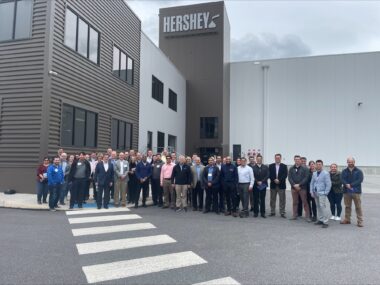
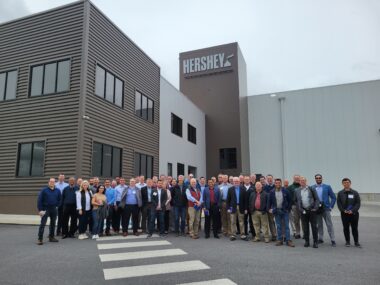
Attendees at the MLC’s Hershey tour were broken into two groups, with simultaneous visits to the West Hershey production plant and Annville Fulfillment Center. Pictured here is the morning group in Annville.
From its namesake chocolate bars to the immensely popular Reese’s Cups, The Hershey Company has been a maker of beloved confections for many decades. But no matter which variety is your personal favorite, Hershey’s powerhouse combination of manufacturing, fulfillment and distribution keeps those famous brands coming to store shelves and to the consumers who love them, generation after generation.
Nearly 100 Manufacturing Leadership Council members took part in a tour encompassing two Hershey facilities: the West Hershey plant in Hershey, Pa., and their nearby Annville Fulfillment Center in Annville, Pa., which is also Hershey’s first fully digital facility.
As a $10 billion publicly traded company, Hershey is perhaps most famous for its chocolate brands and other confections, but it also has expansion goals to evolve into a leading snacking powerhouse. To that end, it has acquired several brands of salty snacks, including Skinny Pop Popcorn, Pirate’s Booty puffs and straws, and Dot’s Pretzels. Its nearly 4,000 SKU brand portfolio is carried out through 21 plants (14 in the United States, seven internationally), roughly 950 global ingredient and packaging suppliers, 60 contract manufacturing and contract packaging partners, 34 distribution centers, and 143 freight carriers.

The afternoon attendees outside of Hershey’s Annville Fulfillment Center.
One thing that leadership emphasized on the tour was Hershey’s move from “best in cost” to “best in class.” Fulfilling Hershey’s vision as a snacking powerhouse means focusing on people-first manufacturing, which includes skill development, career advancement and teambuilding; innovating through technology, including through its digital factory strategy; and a focus on reliability. But in addition to its future aspirations, Hershey also needed to respond to evolving market and operational conditions – the company saw more volume growth during the pandemic, but retirements meant that its mean labor tenure decreased significantly, while lead times for packaging and capital equipment lengthened. Those shifts means that the company was left with a need to respond faster.
Investment in transformation capabilities has been essential. The company has moved away from conventional lines with single-purpose assets and focused SKU portfolios with complex line changeover requirements to advanced technology lines that can handle diverse SKUs with faster cleaning and changeover capabilities. Overall, Hershey’s digital factory strategy is focused on four areas: data capture and analysis to facilitate rapid problem identification and resolution; physical automation; a digital backbone (encompassing universal data architecture), and digital quality to bring forth a paperless shop floor. The company performs mass customization at scale through robotics and digital integration.
During the visit to the West Hershey production plant, which originally opened in 1990, attendees got an inside look at some of the production lines in the world’s largest and most technologically advanced chocolate manufacturing plant (750,000 square feet). It takes 26,000 cows to supply the milk needed to produce the Hershey’s Kisses (70 million a day), chocolate bars and syrup made here – one million pounds each of milk chocolate and Hershey’s Syrup each day. There is no storage for intermediaries at this facility – as soon as products are made, they are put onto a truck.
The 800,000-square feet Annville Fulfillment Center started production in October 2021, going from its groundbreaking to operation in just 16 months. It includes 62 trucking bays and 18 packing cells with flexibility to handle packages anywhere between two ounces and six pounds. Some of its advanced features include a cloud-based technology stack, digital work instructions for operators, and environmentally friendly battery-powered forklifts. The company will continue to scale up operations there as they leverage the facility’s full capacity.
The Annville facility is a joint operation between Hershey and its logistics partner, DHL. While Hershey owns the facility and its capital equipment, the majority of the workforce there are DHL employees. The Annville leadership team says that the partnership capitalizes on the strengths of both organizations, such as Hershey’s digital production know-how and DHL’s warehousing and logistics expertise. The facility utilizes a flex labor setup with cross-training between machine operators, palletizing operators and other functions to ensure that operations are adequately staffed at all times.
During the tour’s panel discussion at the end of the day, leadership emphasized that one important aspect of Hershey’s success is the company culture, originated by founder Milton Hershey more than 100 years ago. Bringing the workforce on board has allowed them to accelerate past “pilot purgatory” for the company’s digital aspirations. Panelists described what they call “Hershey nice” – a mix of collaboration and consensus-building where everyone treats each other with respect. The culture is vested in the company’s success, which therefore means that there is passion to share success and continually strive for improvements.
For that reason and many more, the company behind “the sweetest place on earth” might also be one of the sweetest places to work, and why Hershey is positioned to grow successfully toward its future aspirations – starting on the factory floor and branching out to snack lovers everywhere.