Creating People-Centric Future Factories
Don’t let talent and skill become an afterthought in your Factory of the Future.

If the last two years have taught us anything, it’s that transformation is no longer an option; it’s change or be changed. In 2020, over 50 billion internet-connected things existed. By 2025, over 50% of the global workforce will be digital natives. By 2030, autonomous vehicles will be mainstream. Amid this change, what was once important is now urgent. While most companies have stepped up their spend on digital transformation, few have truly been able to drive value at scale.
As future resilience and agility continue to be critically important, a human-centered Factory of the Future helps plan, prove, and scale value, defining the journey to becoming more digital, more sustainable, and more resilient. But how should companies approach a shift in mindset to a future-focused factory strategy?
Strategic Communication
EY recently worked with a large industrial manufacturer seeking to create a 10-year strategic plan. The company’s customers were demanding more order visibility and enhanced inventory management, as well as reduced lead times. The goal was to identify transformational opportunities through the smart and practical deployment of technology. One of the biggest struggles was communication, particularly trying to get different levels and different regions to understand the broader organizational goals. A series of transformative initiatives were planned, and a case study was developed to help identify potential resources that could assist in shaping the company’s future supply chain, manufacturing, and customer experience, as well as bolster its go-to-market strategy, particularly in the commercial space.
Internal and external discovery was conducted through digital surveys, customer-facing input, detailed benchmarking and functional interviews, which culminated in a maturity analysis against leading practices gathered across industries. The next step was transformation planning through future state visioning sessions, initiative creation, prioritization and building a time-phased road map based on client goals. The final stage, prior to specific technology and process implementation, comprised developing project charters, building a detailed business case and program financials, and setting up a transformation management office to enable long-term change.
“As future resilience and agility continue to be critically important, a human-centered Factory of the Future helps plan, prove, and scale value.”
There are many key aspects that can determine success or failure in the transformation to the Factory of the Future. But this recent experience reinforced one of the most important factors in building an enduring transformation: In the age of digital transformation, a people-centric approach to change is as important as ever. People’s insight, their feedback and their participation in the process are all key to long-term effectiveness.
Connected, Collaborative and Customer Centric
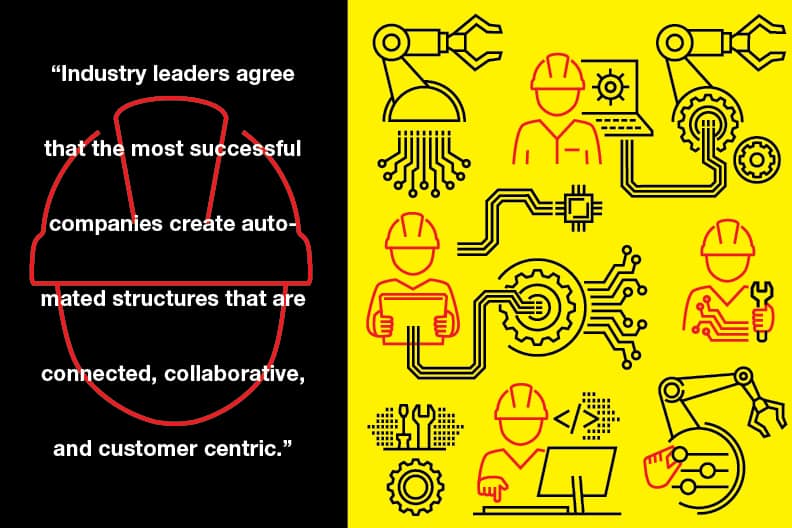
The Factory of the Future concept centers manufacturing leaders around a plan to grow a resilient enterprise with a culture of innovation for now, next, and beyond. This model has evolved as technology has progressed, moving from production automation that was predominantly limited to large manufacturers, to the current AI-driven model that manufacturers large and small are now looking to leverage. While Factory of the Future conversations often center on emerging technologies such as robotics, AI/ML, AR/VR, digital twin, 5G, IoT and blockchain, the definition can vary based on the manufacturer’s industry and maturity level, and it will continue to evolve. Industry leaders agree that the most successful companies create automated structures that are connected, collaborative, and customer centric. They are driven by data and place a high priority on optimization and security. They also understand that, as their respective sectors and the needs of their customers continue to change, their need to remain agile, resilient, and responsive will only grow.
These dynamics were at play for the industrial manufacturer cited above. The company was facing increased pressure from competitors and viewed increased digital capability as a way to maintain competitiveness. It would also position the business to earn more wins in the market and to be better prepared to respond to evolving industry demands.
Digital transformation, when combined with operational excellence and a culture of continuous improvement, can drive the future of manufacturing. It enables improved efficiency, flexibility, and productivity. However, despite significant investments in technology, companies continue to struggle to achieve scale and value. Often, this is due to a lack of a clear enterprise vision. Teams are operating in silos with limited integration using proprietary or home-grown systems. Growth through M&A often creates additional data silos, as well as significant legacy debt across the enterprise.
When Factory of the Future plans focus on technology without the foundation of an enterprise vision or a connection to value for the business and customer, it typically leads to multiple proofs of concepts or pilots that fail to prove value or scale. These flawed models eventually end up in the dreaded pilot purgatory. On the other hand, programs focusing on only operational excellence are successful for a time, but, without a digital platform, they lack staying power and are vulnerable to disruptions.
Frame a Vision
Going back to the earlier example, a number of meetings were conducted with the manufacturer’s entire global leadership team to discuss alignment and to get everyone’s feedback on what was happening. It was very people-centric in the sense that the company went out of its way to engage personnel at all levels of the organization, and across different functions, to understand what challenges would need to be overcome. The goal was to frame a vision that would be beneficial to everyone so that they could feel confident in supporting the effort. The company understood the importance of driving digital transformation as not only a way to achieve specific goals in its business strategy, but as essential components to doing so. Through these conversations, the message came through that it wasn’t, “We’re going to do our business strategy and you’re going to do this digital thing.” It was, “We’re doing this digital transformation as a way to enable our strategy.”
The change management team that emerged through this process focused not just on the technology needed, but also on the internal capabilities that would be required throughout the organization. A robust hiring strategy was crafted to start building and augmenting some of the capabilities that were missing.
The journey to the Factory of Future requires a holistic approach that keeps the focus on a desired business outcome and maintains dialogue to address new developments or ideas that had not been considered previously. Time needs to be taken to create a strategic road map that leads the way from where the company is to where it ultimately wants to go. There is a defined return on investment (ROI), a north star, and a commitment to creating a foundation that integrates enterprise technology, operational technology, and information technology. A clear ROI-led approach should scale digital transformation and focus on value creation, putting humans at the heart of the transformation purpose.
Enabling, Not Replacing, People
With every highly strategic, large-scale initiative, there’s always the following question: How do we determine what comes first, and what are the essential components to drive success? Building a Factory of the Future requires patience, focus, and a willingness to invest in long-term transformative capabilities. Research and engagement with hundreds of organizations has uncovered that more than half don’t know how, or where to begin their transformation. Another quarter are struggling to either prove the value of transforming, or effectively scale the technologies. To overcome these challenges, an approach needs to be developed that is successful in delivering results, creating alignment, and enabling change.
“A clear ROI-led approach should scale digital transformation and focus on value creation, putting humans at the heart of the transformation purpose.”
Experience has revealed the following key characteristics to be common to a successful Factory of the Future transformation:
- Bring a clear focus on connecting technology advancements with operational excellence and data foundation needs, with an emphasis on sustainable value creation. By doing this, manufacturers can eliminate the pilot purgatory that many face as they leverage technology and industry 4.0 use cases that complement their improvement programs and organizational capabilities. Where many organizations have led with the newest technology, successful Factories of the Future are built through the development of people and a connection to existing operational strategies.
- Don’t let new roles and required skills be treated as an afterthought after technologies and structures are already put in place. Roles and skills should be debated and re-examined as plans are developed and the organization’s needs shift. Talent resources and learning plans should be approached through a lens of now, next, and beyond. Upskilling, redeploying, and hiring people will enable the organization to become future-ready while simultaneously empowering employees. Conversations with professionals should be reframed around not just what’s good for the business, but what’s good for them as well. This is an opportunity for employees to grow and gain marketable skills. A clear development path should be set for combining strategic thinking with technical understanding, and performance incentives should be set along the way.
- Follow a future-back approach that complements the need to solve near-term issues while understanding long-term development needs. By looking at time horizons and aligning focus on now, next, and beyond, factories are able to balance the need to deliver quick wins and address foundational gaps while leveraging technologies that enable future development. Companies can get an inside-out and outside-in view of their existing capabilities, as well as paint a picture of how the factory could function in the future. This balance can be highly successful in helping all levels of the organization, from shop floor employees to executives, grasp what a Factory of the Future truly entails, how it looks and feels different, and the scale of the transformation needed.
- Build a robust business case by connecting the company’s Factory of the Future vision and road map to existing core strategic imperatives. This can include everything from market growth to customer retention to product innovation and more. Modeling tools should be leveraged that enable the organization to see impacts on costs and benefits by changing timelines, changing confidence levels on financials, and adding or removing specific activities. Displaying ROI and payback period data allows leaders to garner the support needed for the effort and to monitor improvements in the future.

Throughout this process, the value of maintaining a people-centric approach cannot be understated. Transformations are rarely easy.
Putting People First
Each of these steps can play a key role in enabling manufacturers to effectively create their own version of the Factory of the Future. Throughout this process, the value of maintaining a people-centric approach cannot be understated. Transformations are rarely easy. Technology should be leveraged as a way to enable people, not replace them. This can lead to quicker adoption and more consistent results since the focus on change management allows organizations to bring their employees along the journey, digitizing through them – instead of doing it to them. The ability to get buy-in and support from leaders and those on the front lines in a business can often be the difference between success and a plan that never seems to reach its true potential. M
Also contributing to this article were: EY Partner, Sai Yadati; EY Executive Director, Mark Heidenreich; and EY Senior Manager, Senthil Subramanian.
The views reflected in this article are those of the author and do not necessarily reflect the views of Ernst & Young LLP or other members of the global EY organization.
About the authors:

Scott Dixon is Managing Director of EY’s Digital Manufacturing practice and helps to lead EY’s Advanced Manufacturing & Mobility sector. With more than 35 years of leadership in production operations, IT, and solution and application development, he helps clients begin, maneuver through, and optimize their supply chain and manufacturing operations by providing technology enabled solutions that leverage Smart Manufacturing and Industry 4.0 capabilities.

Greg Wagner is an Engineer and Digital Manufacturing leader at EY. He has more than 20 years of experience working in, and supporting, manufacturing organizations in the areas of engineering, asset reliability, lean six sigma, operations excellence, health & safety, and digital manufacturing. He specializes in the chemicals, oil & gas, and industrial products manufacturing verticals