
Future of Manufacturing Project

Future of Manufacturing Project: The Digital Leader’s Playbook
December 17, 2025Manufacturing leaders must build digital expertise, agility, and cross-functional leadership to navigate AI, data-driven operations, and increasingly interdependent global networks.
Future of Manufacturing Project: The Growing Competition for AI Supremacy
December 11, 2024MLC’s David Brousell says AI is reshaping manufacturing as global competition for AI leadership intensifies, with ChatGPT driving rapid growth, huge investment, and major opportunities and challenges for industry.

Crystal Ball: Business Resilience in 2030 and the Digital Dexterity Effect
December 14, 2023By 2030, manufacturing resilience will depend on digital dexterity: shared governance, data-literate workers, and tech-savvy leaders. Companies should start building digital skills and change management now.

Placing Innovation at the Heart of Transformation
December 1, 2023Manufacturers must put innovation and digital strategy at the center of transformation to navigate disruption, break silos and drive long-term growth. A future-back, enterprise-wide approach helps scale smart products, operations and new business models.

M2030 Perspective: FOMO Can Spark Next Digital Revolution
October 1, 2023AI and ML can help manufacturers make faster, data-driven decisions and improve productivity, scrap reduction and ROI. The article says these tools are business investments that could drive the next digital revolution.

Crystal Ball: Quo vadis, Industry 4.0 and digital transformation?
September 18, 2023In the latest in our Manufacturing in 2030 Crystal Ball series, we look at where Industry 4.0, transformation and digital value creation are headed
Industry 4.0 is reshaping manufacturing with smart, connected factories, mass customization and product-as-a-service models. It helps companies move production closer to customers, improve efficiency and meet sustainability demands.

Crystal Ball: How Data will Drive Seamless Experiences
August 15, 2023What Manufacturers Can Expect by 2030
By 2030, manufacturers will centralize and analyze data from across operations to enable real-time decisions, seamless customer experiences and more autonomous automation. Humans will still remain essential for creativity and oversight.

Crystal Ball: A Futuristic Workforce Odyssey
April 26, 2023For humans and machines to work together by 2030, the workforce evolution must start now
Manufacturing’s 2030 workforce will blend humans, AI, robotics and VR to boost safety, productivity and resilience. Manufacturers are already investing in upskilling, leadership development and future-ready skills.
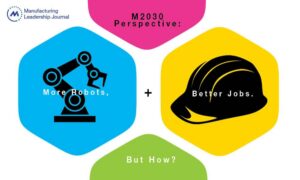
M2030 Perspective: More Robots, Better Jobs. But How?
March 24, 2023Robotics could help factories boost productivity and ease labor shortages by 2030, but adoption requires new skills and process changes. Automation changes workforce challenges rather than eliminating them.

M2030 Perspective: Exploring the Promise of Industrial AI
January 28, 2023Industrial AI is emerging as a human-machine partnership, using sensor-rich manufacturing data to improve models, predict equipment health, and boost productivity.
