Placing Innovation at the Heart of Transformation
To build the right foundation for long-term growth, manufacturers must put innovation and digital strategies at the heart of transformation.

TAKEAWAYS:
● Massive geopolitical, technological and cultural changes have prompted unprecedented shifts in industrial manufacturing.
● As pressures mount to build smart products, digitize operations and exceed customer expectations, incremental approaches to change are falling short.
● Manufacturers need to design a transformation that is innovative, agile, cross-functional, and scalable to realize tangible business value.
Over the last several years, challenges related to geopolitics, technology, the pandemic and climate change have shaken the foundation of industrial manufacturing – creating tectonic shifts in how manufacturers think, operate and deliver their products and services.
The pressure to make products smart and connected, digitize the factory and operations, create more automated and reliable supply chains, and deliver on rising customer expectations presents significant opportunities to move toward radical growth. Yet many manufacturers’ current approaches – driven by siloed teams, functions rather than strategies, and static views of competitive and operational landscapes – present significant risks on the road to reinvention.
Legacy manufacturers trying to speed ahead into the future of smart products, digital platforms and new service-oriented business models urgently need a better way forward. A hybrid, innovation-led approach that incubates future businesses while simultaneously optimizing today’s products and operations can provide practical, value-driven solutions in both the short and long term.
Disruptive Forces Shift Operational Priorities
The range of disruptive forces manufacturers are experiencing has implications across the entire enterprise. These forces include:
- sector convergence
- power shifts within value chains
- evolving customer expectations
- volatile macroeconomic environments
- tougher workforce dynamics
- sustainability pressures
- transformative technologies
In response, manufacturers are prioritizing digital transformation and innovation-related investments. According to the EY January 2023 CEO Outlook Pulse survey, virtually all (97%) of industrial manufacturing CEOs indicated that continuing digital and technology transformation to deliver growth and operational advantages is either a very or fairly important near-term priority, despite near-term economic uncertainty.
Through these investments, manufacturers seek to revolutionize processes by implementing innovations such as digital twins, artificial intelligence and machine learning. At the same time, they are advancing product and service offerings across the value chain that are smart and connected.
However, to fully realize the significant opportunities arising from disruption and the value of these investments, manufacturers must tie them to a unifying vision of where their markets are headed.
Forging a new path to the future will require manufacturers to put their growth agenda at the center of transformation. This plan needs to be backed by a detailed strategic roadmap that accounts for both the innovations needed to succeed and the transformation required to launch and scale these breakthroughs in the market. It must also be developed with an enterprise-wide outcome in mind, breaking down functional and geographic silos.

Once a decision is made to pursue small- or large-scale reinvention, manufacturers can maximize the speed, agility and long-term value generation by adopting the following best practices.
Start With the End in Mind But Also Know Where to Begin
With business challenges clearly defined, manufacturers should explore solutions using a future-back approach that starts with the end in mind. The critical first step involves rapidly defining and assessing tomorrow’s potential futures from the outside-in, and predicting how these future scenarios may shape customer needs, market conditions and value pools across time horizons. In parallel, organizations must also perform a thorough review of their current capabilities, particularly those that may play an increasingly important role in future competitiveness.
Taken together, assessments of a company’s current state and potential futures serve as the foundation of a new strategy that will act as the transformation’s North Star – guiding it relative to the level of ambition, while optimizing development speed and investment spending. This strategy should also provide a framework for cross-enterprise transparency and engagement.
Image 2: Our approach to transformation
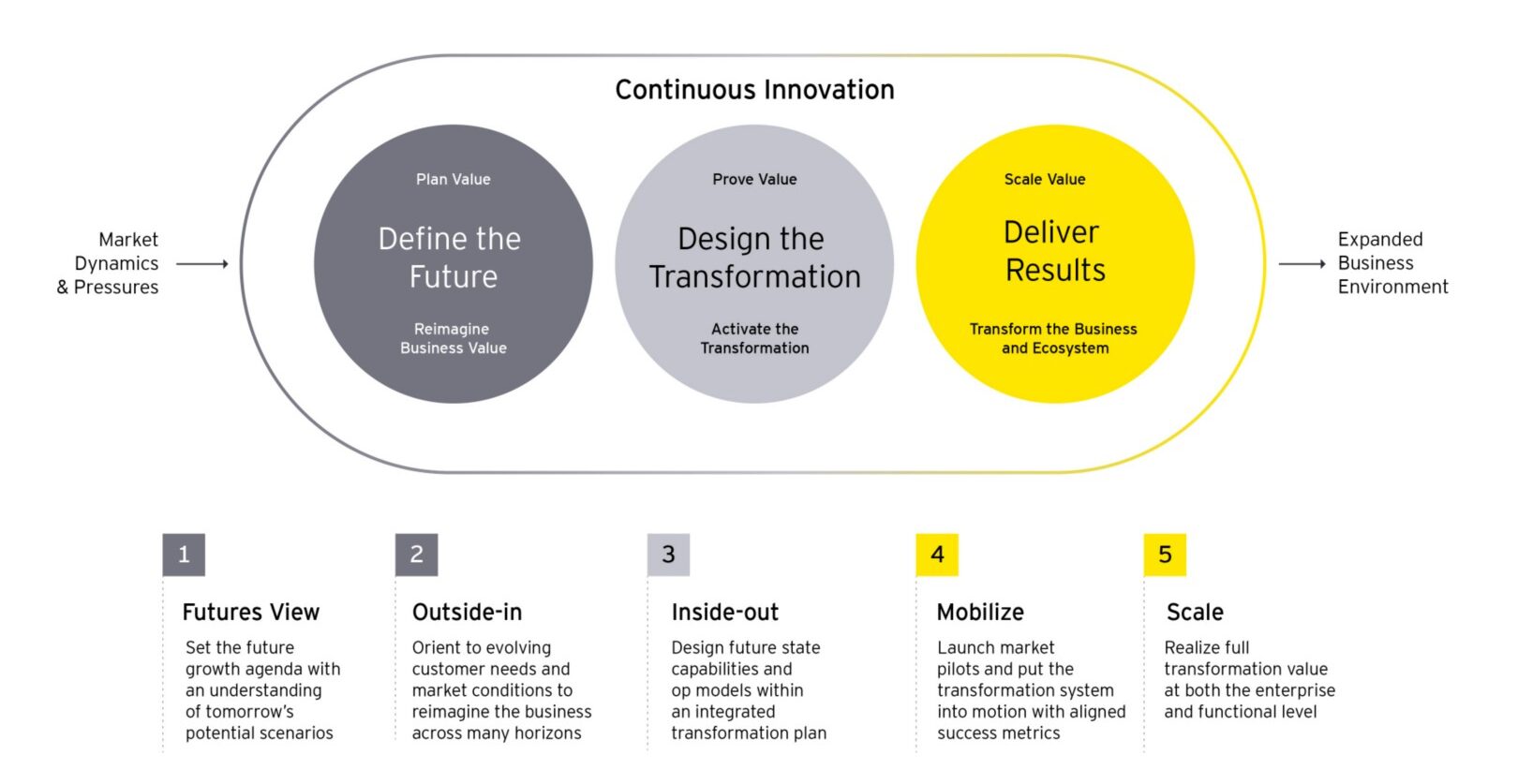
Image 2: A chart showing the continuous innovation process which defines the future growth agenda, designs the transformation plan to deliver results both at the enterprise and functional level. Source: EY
Design the Transformation With a Hands-On Approach to Innovation
Rapid prototyping is an essential step for manufacturers to substantiate their future views and refine perspectives on must-have innovations. Multiple, accelerated iterations of both physical products and digital offerings are important for assessing features and costs in the context of various customer expectations, demand levels and competition scenarios.
Making the future tangible will pay dividends in the design phase of the transformation. Understanding necessary enterprise-wide adaptations – from specific technology or talent enhancements to new business models – will inform an achievable, cross-functional plan. The ability to “show your work” will also help build support across various internal constituencies as they are enlisted in the effort.
Start with the end in mind
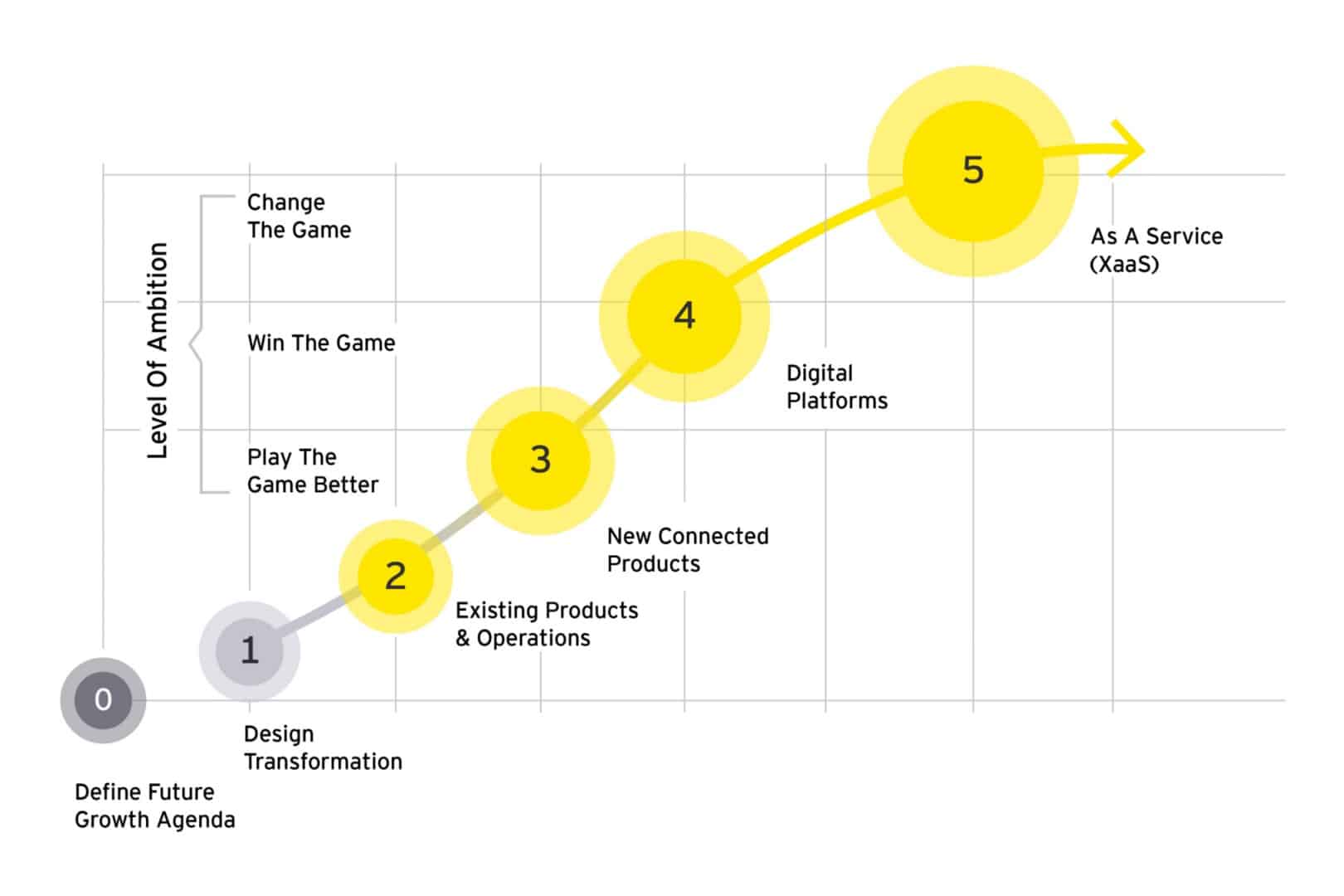
Image 3: A chart showing the continuous innovation process which defines the future growth agenda, designs the transformation plan, analyzes existing products and operations, connects new products, embeds digital platforms to redesign As-A-Service (XaaS). Source: EY
Accelerate Results By Incubating New Business Model Concepts
When future growth depends on technologies, customer expectations or new value pools that are not addressed by a manufacturer’s current core competencies, innovation at the business model level may be a solution. For example, what are the implications of collecting, analyzing and monetizing data from a new connected product? Successfully assessing and addressing these impacts could enable manufacturers to leapfrog the competition.
Given the enterprise-wide implications of such changes, legacy manufacturers should prioritize small-scale experimentation with a lean, internal start-up style approach. In conjunction with ongoing physical product innovation, manufacturers will want to invest in teams to explore the internal and external infrastructure and capabilities needed to support an operating model for an offering’s full lifecycle. This approach can be particularly beneficial for evaluating the technology infrastructure required for a potential new business model. By using focused, lean teams, manufacturers can leverage agile sprints to further define capabilities and architectural requirements as the transformation progresses.
Jerry Gootee is EY’s Global Advanced Manufacturing Sector Leader

Claudio Knizek is EY-Parthenon’s Global Advanced Manufacturing and Mobility Leader