M2030 Enabling the Future of Enterprise-wide AI/ML
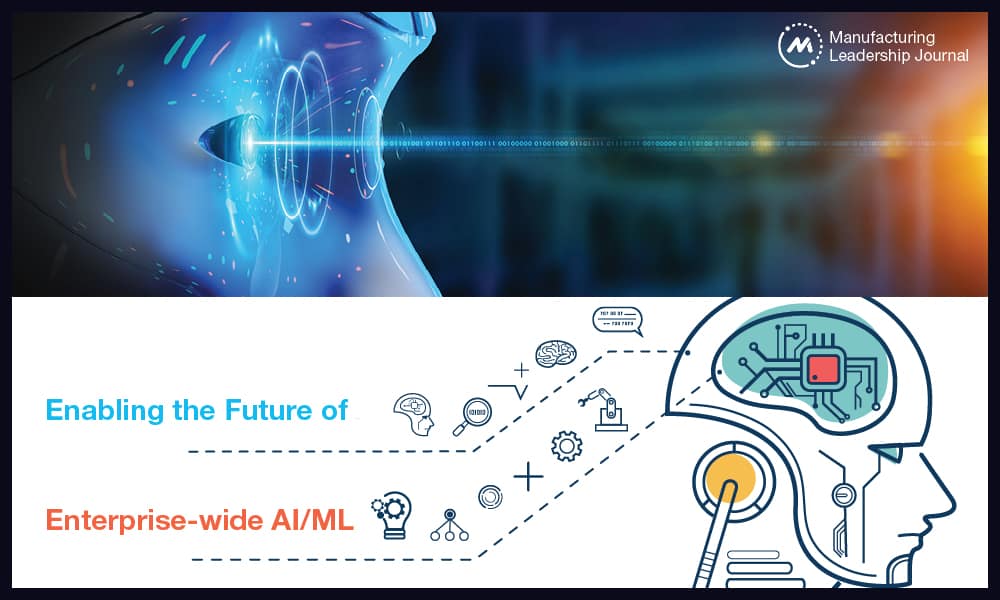
Augmenting AI/ML with enterprise systems allows manufacturers to create self-learning knowledge systems that will help them transform their businesses by 2030.

Manufacturing in 2030 will largely be the story of next level digitization on steroids. The popular adage Every Business Is a Digital Business, will become a living reality for global manufacturers. The pandemic-led changes in customer behavior over recent years will continue to accelerate trends towards software solutions and data platforms. Agility, dynamism, sustainability, and customer-centricity will change business models and organizational structures around concepts of autonomy, Servitization, self-fulfillment, circular-economy, and virtualization. Data-driven Servitization models will become core for manufacturers and digital technologies will help companies fundamentally reinvent internal processes.
The upcoming decade is also the story of a transition from the current Industry 4.0 paradigm, to the Industry 5.0 paradigm, the next step in the evolution of manufacturing processes around the notion of machine-assisted humans. Industry 5.0 will also see the next stage of industrial IoT, as well as the widespread adoption of industrial AI – the systematic combination of AI technology with industrial systems that include humans in the loop. Driven by this human/robot collaboration, organisations will be more empowered to improve their triple bottom line of People, Planet, and Profit.
Today, artificial intelligence is already completely transforming the services sector. Manufacturing is next. Powerful cognitive applications are slated to transform the entire gamut of manufacturing operations over the decade ahead from production to supply chains to aftermarket activities.
Delivering value will also rapidly shift from products to data-driven service models for most B2B companies in this decade. While the product itself may previously have been the link holding together B2B relations, this decade will be about customer centricity with a key focus on individual customers and their purchase journey from product identification to aftersales. For manufacturers, this trend implies the transformation of core business models, initiating new operating paradigms and the monetizing of data. This makes Artificial Intelligence and Machine learning (AI/ML) a top technology priority over the next few years.

Companies aiming for exponential adoption of AI/ML in their organization should focus on AI/ML enabled decision making as a competency rather than focusing on specific tools and technologies. They also need to consider how to best integrate previously siloed ERP products with cloud technologies and new AI/ML functionality to ensure that all their teams, business units, and locations can make decisions in sync with the real-time state of operations. They should also be aware that the wide-scale adoption of AI/ML is most successful when its deployment expands beyond dedicated data-scientists to the wider organization. So, having programs or partners in place to help spread awareness and develop new skills among key team members across the enterprise can help drive faster adoption, encourage front-line innovation, and deliver greater value.
These considerations are crucial in today’s business context, where customers are keen to leverage AI but hesitate because of complexity, time and cost associated with such projects.
.