
Revolutionizing EV Battery Manufacturing with Data and Smart Factory Technologies
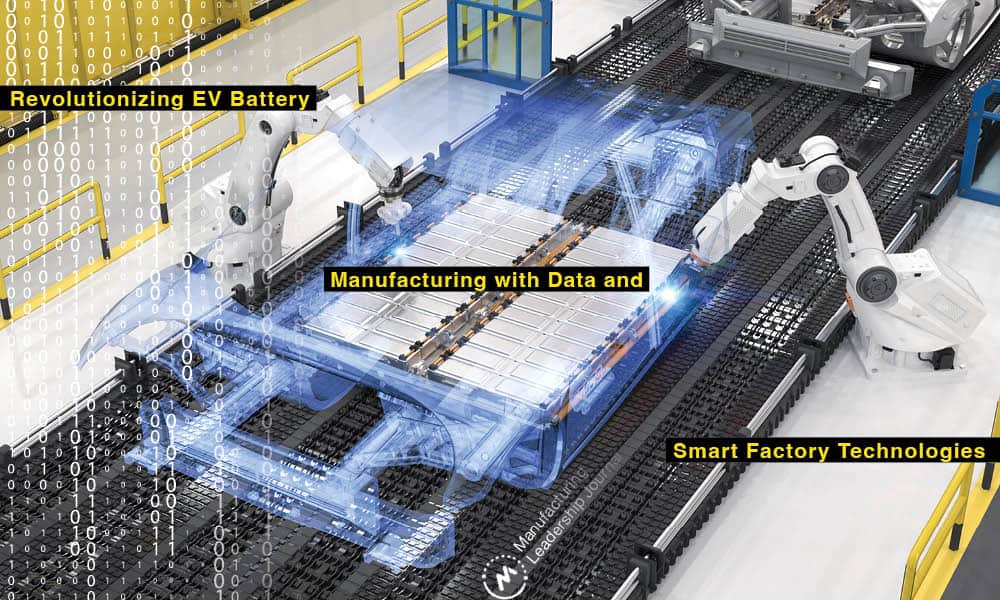
Manufacturers of electric vehicle batteries need to develop a data-driven operating model that is efficient and resilient with room to scale as EVs grow within the automotive industry.

TAKEAWAYS:
● Manufacturing 4.0 principles are informing the strategic direction of EV battery manufacturers, shaping their approach to personnel, digital transformation and supply chain.
● Data will give manufacturers greater understanding of the materials being used, helping them to find ways to innovate and improve efficiency and productivity.
● AI and blockchain technology can give battery manufacturers tools to more quickly adapt when setbacks occur, reducing waste and enhancing quality.
In an era when efficiency and innovation are paramount, the emergence of smart factories has marked a significant shift in manufacturing paradigms. These advanced manufacturing facilities leverage data, automation and technology to create more efficient and adaptable production processes. Central to this evolution is the integration of Manufacturing 4.0 strategies with overarching business objectives.
In the EV battery manufacturing sector, where precision and reliability are critical, leveraging transformative, data-driven technology is pivotal to surmounting business challenges and enhancing performance in battery manufacturing. The M4.0 best practices emerging for battery manufacturers also offer lessons for manufacturing in other sectors and industries.
EV Battery Market Still Evolving
The alignment of M4.0 strategies with business goals is crucial in the battery industry. Battery manufacturers need to explore business model innovation and find ways to drive peak profitability within their core business while simultaneously incubating new revenue streams. They need to not just retain customers, but also capture new ones and deliver an experience that is results-driven, personalized and responsive.
They also need to build resilience in their operating models, leveraging emerging technology to future-proof their supply chains. And EV battery manufacturers must enable talent on multiple levels, making it easier for employees to embrace digitalization and develop new capabilities.
Data-driven approaches underpin this integration, facilitating informed decision-making that streamlines production, improves output, and enhances metrics like yield and ramp-up times. Incorporating deep mineral and component analytics into these strategies allows for a more comprehensive understanding of materials and their impact on EV battery quality, performance and maintenance. This alignment not only boosts operational efficiency, but also fosters innovation in battery design and functionality, crucial for industries like the EV sector, which demands rapid production of high-quality batteries and aims to avoid future liabilities such as recalls.
Regulation and standardization is another element that will shape the EV battery market. It could bring much-needed consistency and structure to a sector that is still seeking broader acceptance from consumers who need confidence that service for EVs will be as accessible and user-friendly as the structure they’ve used for internal combustion engine vehicles. At the same time, regulation and standardization can feel limiting to those with a more innovative approach to business and market growth.
The views reflected in this article are the views of the author(s) and do not necessarily reflect the views of Ernst & Young LLP or other members of the global EY organization.