
The Data Monetization Wave Picks Up Speed

The generative AI tool ChatGPT has raised the competitive stakes, requiring manufacturers to embrace the discipline with greater urgency.

TAKEAWAYS:
● The myths and realities of data monetization.
● A framework for identifying and measuring the potential value of direct and indirect data monetization opportunities.
● How generative AI is a game changer for data analysis, valuation, and monetization.
In the Manufacturing Leadership Council’s recent research, Manufacturing in 2030 Survey: A Lens on the Future, 84% of respondents said they expect the pace of digital transformation to accelerate. That means data—more of it and more opportunity to create value from it.
Extracting value from manufacturing data has been rising up the industry agenda in recent years—fueled by success stories from leaders such as Navistar Internal Corporation, which used to rely on miles traveled or time since the last service appointment to develop vehicle maintenance schedules. By introducing new capabilities to analyze sensor data from 375,000 connected vehicles, Navistar has helped vehicle owners reduce maintenance costs by up to 40%.
The industry’s mushrooming volume of data is reason alone to be thinking about data monetization. Then ChatGPT entered the conversation in late 2022—raising the stakes. With generative AI, a user can now formulate a question and feed it into the model, which queries multiple data sources—potentially even integrated data, such as that from a CMMS system. The output provides an explanation of what the problem could be, the tools/parts needed, and a step-by-step explanation of how to fix the problem. This saves significant time and costly trial and error, becoming a source of value. The very human nature of the interaction addresses one of the big challenges with which manufacturing has been grappling: how to equip its workforce with skills to use data in a digital world.
Competition among Microsoft, Google, and others will only accelerate generative AI capabilities as well as business interest in using them. We can expect to soon see it embedded in workplace technologies, enterprise resource planning systems, and other business applications. That means it’s not a question of if, but when generative AI will be able to fully ingest and use a company’s own data and what it scrapes from the web. While AI communities are eagerly anticipating this, so should data-rich manufacturers because it significantly increases the potential for turning data into value.

West Monroe defines data monetization as the process of generating new and innovative measurable value streams from available data assets.
There are several key words in that definition. First, data monetization is a process, not a one-time activity. Applying a product mindset—one that focuses on delivering value rather than milestones—is important. A value stream is about generating measurable benefits. If you aren’t connecting the dots from business value to the data used, then you can’t really claim that you’re monetizing the data. Finally, available data assets is not just about the data inside your four walls. It also includes social media data, partner/supplier data, customer data, and open data sources, among others. Data monetization is about harvesting content to enrich and enhance your own data and make it that much more marketable and usable.
Two Types of Data Monetization
We’ve identified about a dozen data monetization patterns. These generally fall into two categories—indirect and direct. Indirect data monetization focuses on internal business processes that generate measurable returns. Direct data monetization involves externalizing data in return for some type of commercial consideration.
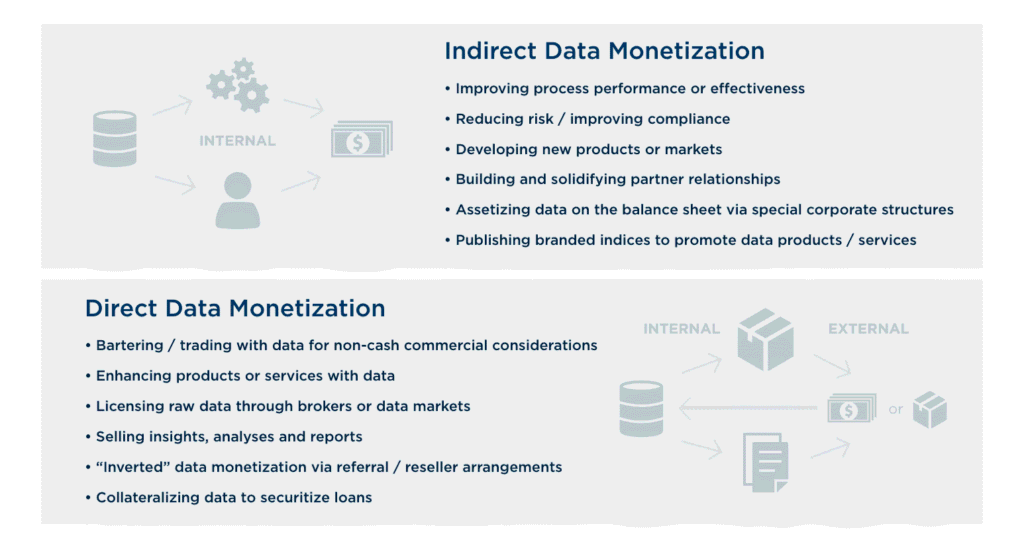
Most manufacturers that have pursued data monetization focus on indirect opportunities. Some have made good progress; for example, with AI/ML models that can predict an outcome (will the machine go down?) or aid decision-making (should we replace or repair?). With new capabilities to analyze data, Harley-Davidson was able to predict machine failures with a very high degree of accuracy, thus reducing unplanned downtime and increasing production capacity 8-10%.
The emergence of generative AI creates bigger and better opportunities for indirect monetization and for direct monetization due to the breadth of data now valuable outside the company. As manufacturers consider new use cases, the need for third-party data will increase, making data (both volume and variety) more valuable on data exchanges.
Naturally, this also raises new questions about data ownership, including who owns the data scraped by the model and whether/how they should be compensated? Consider, for example, the data produced and captured by manufacturing equipment used in a factory: Is that the equipment OEM’s data or the manufacturer’s data?
In any event, keep in mind that it is not the generative AI model that has value. The value is in the data itself and the productivity of using it more effectively to produce insights, content, or other commercial benefit. And that brings us to packaging.

There are literally dozens of types of manufacturing data that may have value in some form of packaging along the spectrum above.

Getting Started or Back on Track
Whether you’re just starting or have explored data monetization but stalled, your organization will need an approach grounded in creating both momentum and value. Again, this is a process, not a one-time activity. It will also require a dedicated leader or team to own and support the process. West Monroe breaks data monetization into about a dozen discrete steps that fall into three basic phases:
1. Generate and prioritize ideas
2. Define the use case or data product requirements and features, collaboratively with stakeholders inside and outside of the business
3. Engineer, introduce, learn from the results and feedback, and improve continuously using rapid iterations to shorten the time to value
If this looks familiar, it is. It comes directly from well-honed R&D and product management playbooks.
Ideation workshops or exercises should start with your organization’s business drivers and identify those where you have the most potential for creating impact with data and analytics. Get a cross-functional group in a room to bring as many perspectives to the table as possible. And aim to develop as many ideas as possible.

One way to frame an ideation exercise is to identify situations where it would be valuable to have more prescriptive, predictive, or diagnostic insight. In manufacturing, considerable effort still goes into reporting on the past—what was sold or how costs fluctuated last quarter. What’s more valuable is understanding why you only sold that much, how much you’re going to sell next quarter, or how you could sell even more.
Another potential starting point is to identify data with the greatest potential value inside and/or outside your organization. Characteristics of highly monetizable data include such things as degree of control or ownership, uniqueness (others do not have data like it), meaningful context, security, accuracy, and availability. If you have data that meets many of these characteristics, compartmentalize it and make sure you begin treating and managing it as an asset, even as you develop your strategy for monetizing it.
Take inspiration from what other organizations are doing, both in and beyond the manufacturing sector. We recommend referencing Data Juice for real-world stories, including several from consumer and industrial products organizations.
Finally, look for other business or IT initiatives already underway that can help in gathering, preparing, or using data in new ways. This is often a way to accelerate new initiatives that may otherwise be challenging to get off the ground.
As you begin to prioritize ideas, employ a feasibility assessment that considers factors such as complexity, cost, and magnitude of benefits. One way to compare and rank ideas is to plot them according to impact and complexity. Those with low complexity and high impact are candidates for rising to the top of the priority list.
David McGraw, Senior Manager, Consumer & Industrial Products, West Monroe

Tim Wrzesinski, Director, Technology, West Monroe